

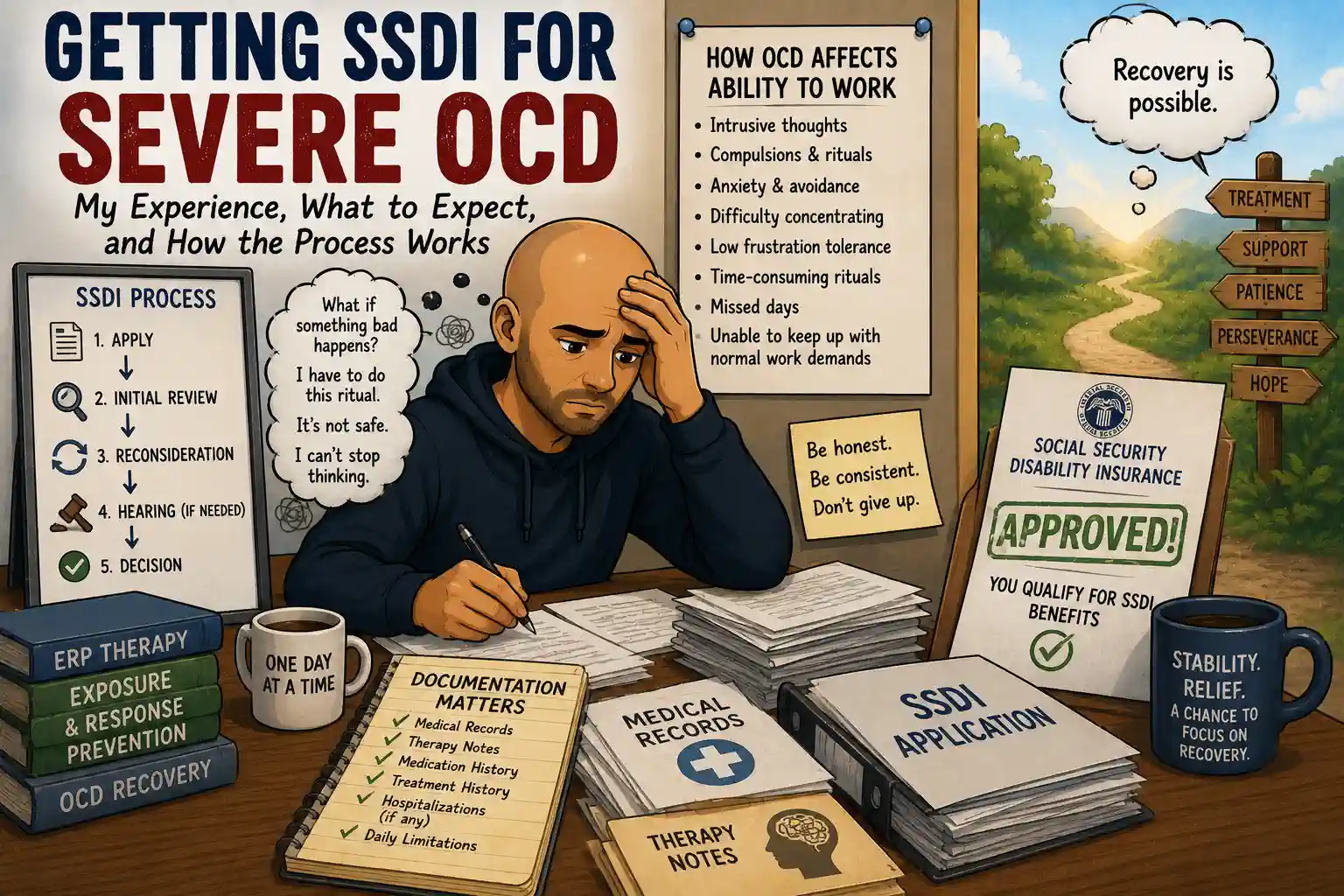
Getting SSDI for Severe OCD: My Experience and What to Expect
One of the most common questions I see people ask is whether it is possible to receive SSDI for obsessive-compulsive disorder. The short answer is yes. People are approved for SSDI because of OCD every year.
However, being approved is often not easy, and many people underestimate how much documentation and patience the process requires.
I was approved for SSDI because of severe OCD, so I wanted to share both my personal experience and some general information about how the process works.
As always, this article is based on my experience and publicly available information. It is not legal advice.
Can OCD Qualify for SSDI?
Yes.
Social Security recognizes obsessive-compulsive disorder as a potentially disabling mental health condition.
The important thing to understand is that Social Security does not approve people simply because they have a diagnosis.
Millions of people have OCD and continue working. What Social Security wants to know is how severely the condition affects your ability to function and maintain employment.
In other words, the diagnosis matters, but the limitations caused by the diagnosis matter even more.
Documentation Is Everything
If there is one lesson I learned from the process, it is that documentation matters.
Medical records matter.
Psychiatric records matter.
Therapy records matter.
Medication history matters.
Hospitalizations, if applicable, matter.
The more evidence you have showing a long history of treatment, the stronger your case generally becomes.
Social Security is looking for evidence that your condition is real, severe, ongoing, and significantly limits your ability to work.
Simply telling them you have severe OCD is usually not enough.
You need documentation supporting those claims.
My Own Experience
My OCD was not mild.
It affected almost every area of my life.
I dealt with severe compulsions, intrusive thoughts, magical thinking, metaphysical contamination, triggering words, rituals, and avoidance behaviors.
Ordinary daily tasks could become difficult or exhausting.
Getting dressed could become a ritual.
Leaving the house could become a ritual.
Crossing a property line could become a ritual.
Entire days could be consumed by OCD.
The condition affected my ability to function consistently and maintain employment.
By the time I applied, there was already extensive documentation showing a long history of treatment and impairment.
That documentation became one of the most important parts of my case.
Do You Need an Attorney?
Many people automatically assume they need a disability attorney from the beginning.
The reality is more complicated.
Some people are approved without an attorney.
Some people are approved on their first application.
Others are denied and later approved during reconsideration or appeal.
There is no single path that everyone follows.
If your documentation is strong and your condition is clearly disabling, approval can happen without legal representation.
That said, attorneys can be extremely valuable if you are denied.
Many disability attorneys work on contingency, meaning they only receive payment if you win your case.
If you receive a denial, I generally think it is worth speaking with an attorney to discuss your options.
Why So Many People Get Denied
Many initial applications are denied.
This is not unique to OCD.
It happens across many different disabilities.
Sometimes records are incomplete.
Sometimes Social Security believes additional evidence is needed.
Sometimes they determine that the person may still be capable of certain types of work.
A denial does not automatically mean your case is hopeless.
Many successful claims are approved during later stages of the process.
The Importance of Treatment
One thing Social Security generally expects to see is that you have attempted treatment.
This can include medication, therapy, ERP treatment, psychiatric care, or other recommended interventions.
If a person has never sought treatment, Social Security may question how severe the condition actually is.
That does not mean treatment must completely eliminate symptoms.
Many people with severe OCD continue struggling despite treatment.
What matters is that there is evidence showing the condition persists despite reasonable efforts to improve it.
How Long Does It Take?
One of the hardest parts of SSDI is the waiting.
The process is not fast.
Depending on where you live and what stage your case reaches, it can take many months.
In some situations, it can take more than a year.
Cases that require appeals or hearings can take significantly longer.
Current backlogs and staffing shortages have created delays in many areas of the country.
Unfortunately, patience is often required.
What Social Security Really Wants to Know
When I look back at the process, I think many applicants focus on the wrong question.
They focus on proving they have OCD.
The diagnosis itself is usually not the difficult part.
The real question is this:
How does OCD affect your ability to function consistently and maintain employment?
Can you complete tasks reliably?
Can you maintain attendance?
Can you stay focused?
Can you handle normal workplace demands?
Can you interact appropriately with others?
Can you perform work on a sustained basis?
These are the kinds of issues Social Security often examines.
Final Thoughts
If you are considering applying for SSDI because of severe OCD, my advice is simple.
Document everything.
Stay in treatment.
Keep copies of medical records when possible.
Be honest about your symptoms and limitations.
Do not exaggerate, but do not minimize your struggles either.
And if you are denied, do not automatically assume the process is over.
Many people are eventually approved after appealing their decision.
For me, SSDI provided stability during a period when OCD had taken an enormous toll on my life.
I would have preferred not to need disability benefits at all, but I am grateful they existed when I needed them.
Most importantly, remember that being approved for SSDI is not a judgment about your value as a person.
It is simply recognition that severe OCD can be a genuinely disabling condition, and that some people need support while they continue fighting it.