

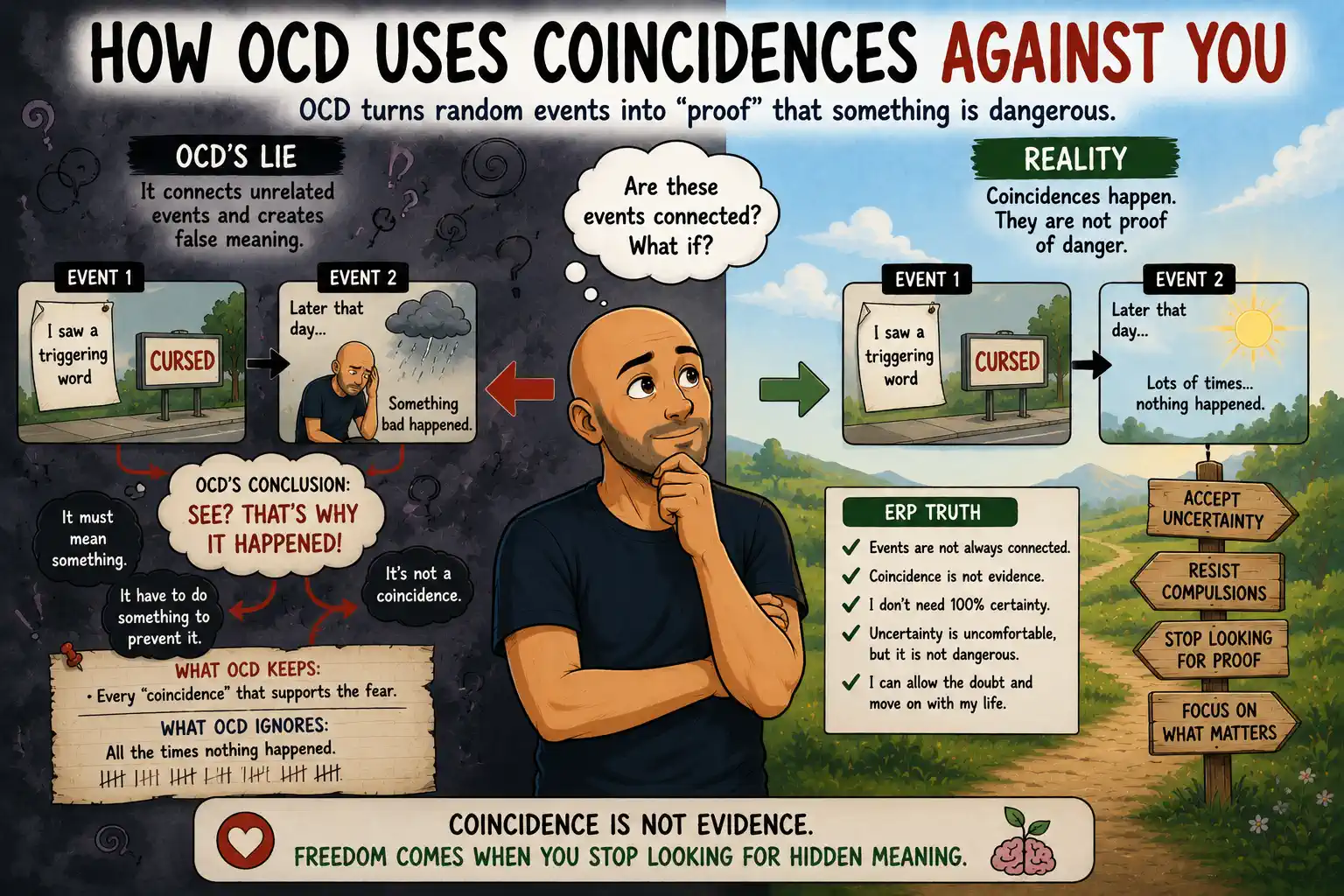
How OCD Uses Coincidences Against You
One of OCD's favorite tricks is taking a coincidence and turning it into evidence.
Something happens.
Then something else happens.
Most people would see two unrelated events.
OCD sees a connection.
At least that is what it wants you to believe.
The Coincidence Trap
Life is full of coincidences.
Good things happen. Bad things happen. Random things happen.
Most of the time we do not think much about them.
OCD is different.
OCD notices a coincidence and immediately asks a question.
"What if these two things are connected?"
That question sounds harmless at first.
The problem is that OCD rarely stops there.
Once the possibility enters your mind, OCD begins building a story around it.
My Experience With Coincidences
Many of my strongest OCD fears involved coincidences.
I would encounter a triggering word, phrase, or song.
Later that day something bad would happen.
Maybe it was a disagreement.
Maybe plans changed.
Maybe something simply did not go my way.
Most people would see normal life.
My OCD would point to the trigger and say:
"See? That is why it happened."
Suddenly a coincidence became proof.
At least it felt like proof.
What OCD Never Counts
The strange thing is that OCD keeps score unfairly.
It remembers every coincidence that supports the fear.
It ignores every coincidence that does not.
If I saw a trigger and later had a bad day, OCD remembered it.
If I saw the same trigger a hundred times and nothing happened, OCD ignored those examples.
This creates the illusion that the fear is constantly being confirmed.
In reality, OCD is only showing one side of the evidence.
Magical Thinking Loves Coincidences
This is one reason magical thinking OCD can feel so convincing.
The brain starts connecting unrelated events.
A word becomes linked to bad luck.
A song becomes linked to failure.
A number becomes linked to danger.
A random event becomes linked to a future outcome.
Once OCD creates the connection, every coincidence seems to strengthen it.
The more attention you give the connection, the stronger it feels.
The Problem With Looking For Proof
For years I tried to prove OCD wrong.
I analyzed events.
I replayed memories.
I searched for certainty.
The problem was that OCD could always invent another possibility.
No amount of analysis ever felt complete.
No amount of evidence ever felt enough.
That is because OCD was never really searching for truth.
It was searching for certainty.
And certainty is impossible.
What ERP Taught Me
ERP taught me that I do not have to solve every coincidence.
I do not have to figure out whether two unrelated events might somehow be connected.
I do not have to prove OCD wrong every time it creates a story.
Instead, I can acknowledge the uncertainty and move on.
Maybe the events are connected.
Maybe they are not.
That answer feels uncomfortable.
But it breaks the cycle.
Coincidence Is Not Evidence
One of the most important lessons I have learned in recovery is that coincidence is not evidence.
Just because two things happen close together does not mean one caused the other.
Life is messy.
Random things happen every day.
OCD wants to turn randomness into meaning.
It wants to turn coincidence into proof.
It wants to turn doubt into certainty.
But the more I step back and look at the bigger picture, the more I realize that many of the connections OCD created were never there in the first place.
They were coincidences.
Nothing more.