

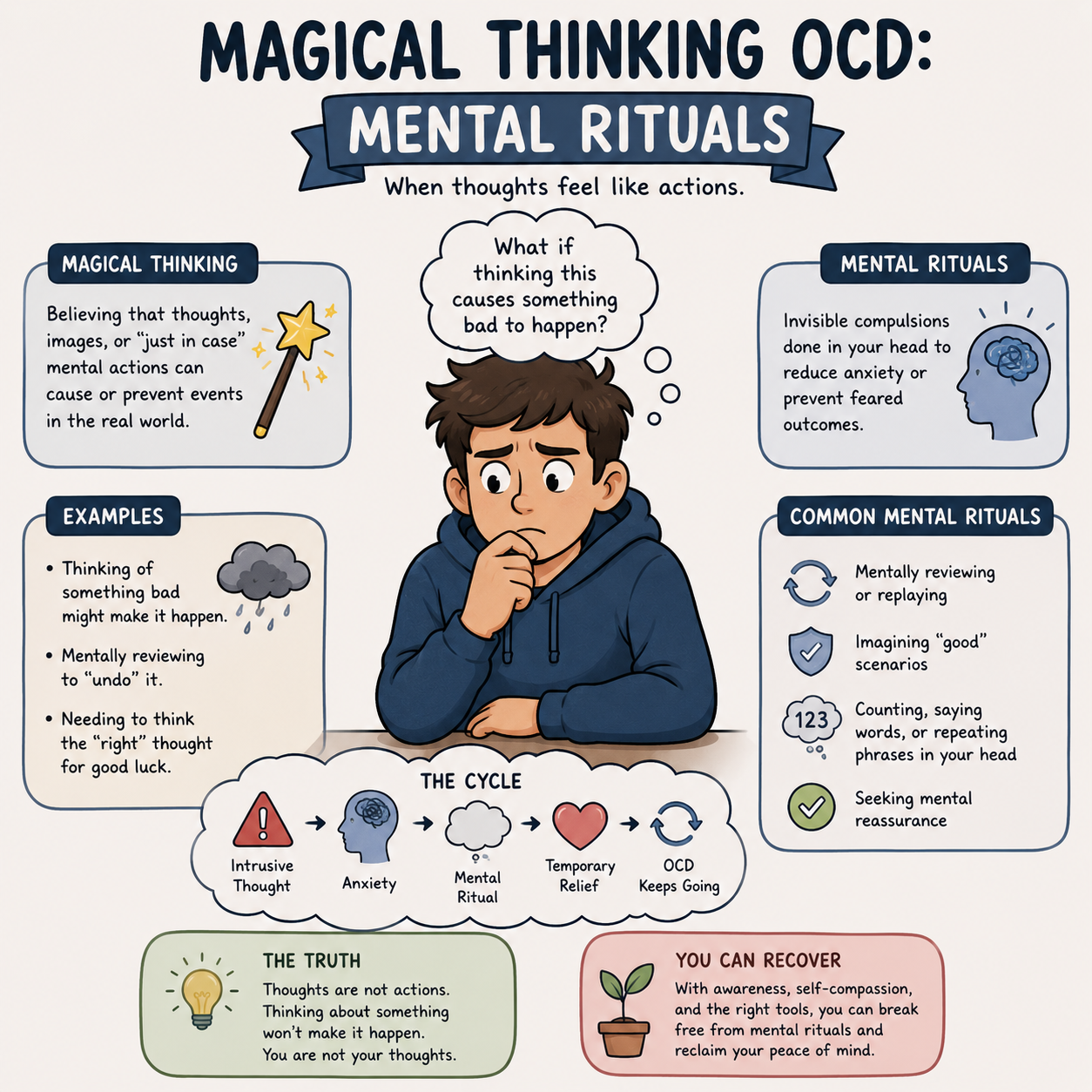
Magical Thinking OCD: What It Is and What It Feels Like
Magical thinking OCD is a subtype or theme of obsessive-compulsive disorder where a person feels as if their thoughts, words, actions, images, or rituals can somehow influence events in the real world.
It can also include metaphysical fears, such as believing an object is contaminated with bad luck, a curse, or some kind of invisible harm. Magical thinking can take many forms, and for some people it becomes extremely complex.
This is the type of OCD I live with.
What Magical Thinking OCD Feels Like
In my experience, magical thinking OCD feels like an extreme form of superstition, but much stronger and harder to ignore.
It can involve mental rituals, physical rituals, repeated checking, repeated movements, specific words, names, phrases, images, and rules that make no logical sense but feel urgent in the moment.
The fear is not always easy to explain. Sometimes it is not simply, “Something bad will happen.” Sometimes it feels more like, “This action is wrong unless I complete it with the correct thought, image, or feeling.”
That is what makes it so exhausting.
My Washing Machine Ritual
One example from my own life involved starting the washing machine.
When I pressed the start button, I felt like I had to hold a certain series of mental images, phrases, and thoughts in my mind. If I got one part wrong, I had to press the button again and repeat the process.
Sometimes it took me dozens of tries just to start a load of laundry.
My therapist gave me a simple but difficult ERP challenge: press the button once and walk away.
He told me that if I did it once, I might feel terrible. But if I did it repeatedly, maybe 20 times, eventually my brain would start to realize there was no real danger.
He was right.
Today, that specific washing machine ritual no longer controls me. Other OCD themes have taken its place, but that one lost its power because I practiced disobeying it.
Property Lines and Mental Rituals
Another major theme for me involves crossing property lines.
When I cross a property line, my OCD may demand that I remember a long list of images, phrases, people’s names, places, and other mental items in a very specific way.
If I get something wrong, or if it does not feel right, I may feel the urge to go back and cross the line again.
At times, this ritual has taken hours out of my day. There have been days when I left and re-entered a property many times because OCD said I had not done it correctly.
This is one of the most disabling parts of my OCD.
Getting Dressed With Magical Thinking OCD
Getting dressed has also been difficult.
Sometimes I feel like I have to touch each piece of clothing while having the correct series of thoughts, images, or phrases. If something feels wrong, I may feel like I cannot wear that item.
Even worse, I may leave the house and later question whether I completed the ritual correctly. Then the doubt starts. Did I think the right image? Did I miss something? Did I do it wrong?
That doubt can become so strong that I feel pulled to return home and change clothes.
That is how magical thinking OCD can turn simple daily tasks into long, exhausting battles.
ERP and Disobeying OCD
Exposure and Response Prevention, or ERP, has been one of the most important tools for me.
ERP teaches you to face the fear without doing the compulsion. In simple terms, it means disobeying OCD and allowing the anxiety to rise without trying to neutralize it.
That is not easy. In fact, it can feel brutal at first.
But the more I disobey OCD, the more I learn that OCD is lying to me.
Nothing bad has ever happened because I refused to obey one of these rituals. The fear feels real, but the threat is not real.
Medication and Magical Thinking OCD
Medication has also helped me.
I am currently working with a psychiatrist and using Prozac along with an augmentation medication. In my experience, the augmentation medication has helped reduce the reward or urge connected to compulsions while the Prozac continues to build up in my system.
I cannot say yet how much Prozac itself is helping because I still need to give it a full treatment window. OCD medication often takes time, especially at higher doses used for OCD.
Still, so far, medication has been one of the most helpful parts of my treatment.
Magical Thinking OCD Can Change Over Time
One frustrating part of OCD is that triggers can grow, shrink, disappear, or be replaced by new ones.
My list of triggers has grown at times, but it has also shrunk when I forced myself to face them. Sometimes it takes me weeks to add a new trigger to my ERP work, but eventually I try to get there.
That is the process.
It is not perfect. It is not fast. But it is still progress.
Final Thoughts
Magical thinking OCD is difficult to explain to people who have never experienced it. From the outside, the rituals may look irrational. From the inside, they can feel urgent, threatening, and almost impossible to ignore.
But OCD is not telling the truth.
ERP has taught me that I can disobey the fear and survive the discomfort. Medication has helped lower the intensity. Treatment has given me tools that I did not have before.
If you live with magical thinking OCD, you are not alone. Your themes may be different from mine, but the pattern is similar: OCD demands certainty, rituals, and obedience.
Recovery starts when we begin choosing uncertainty instead.