

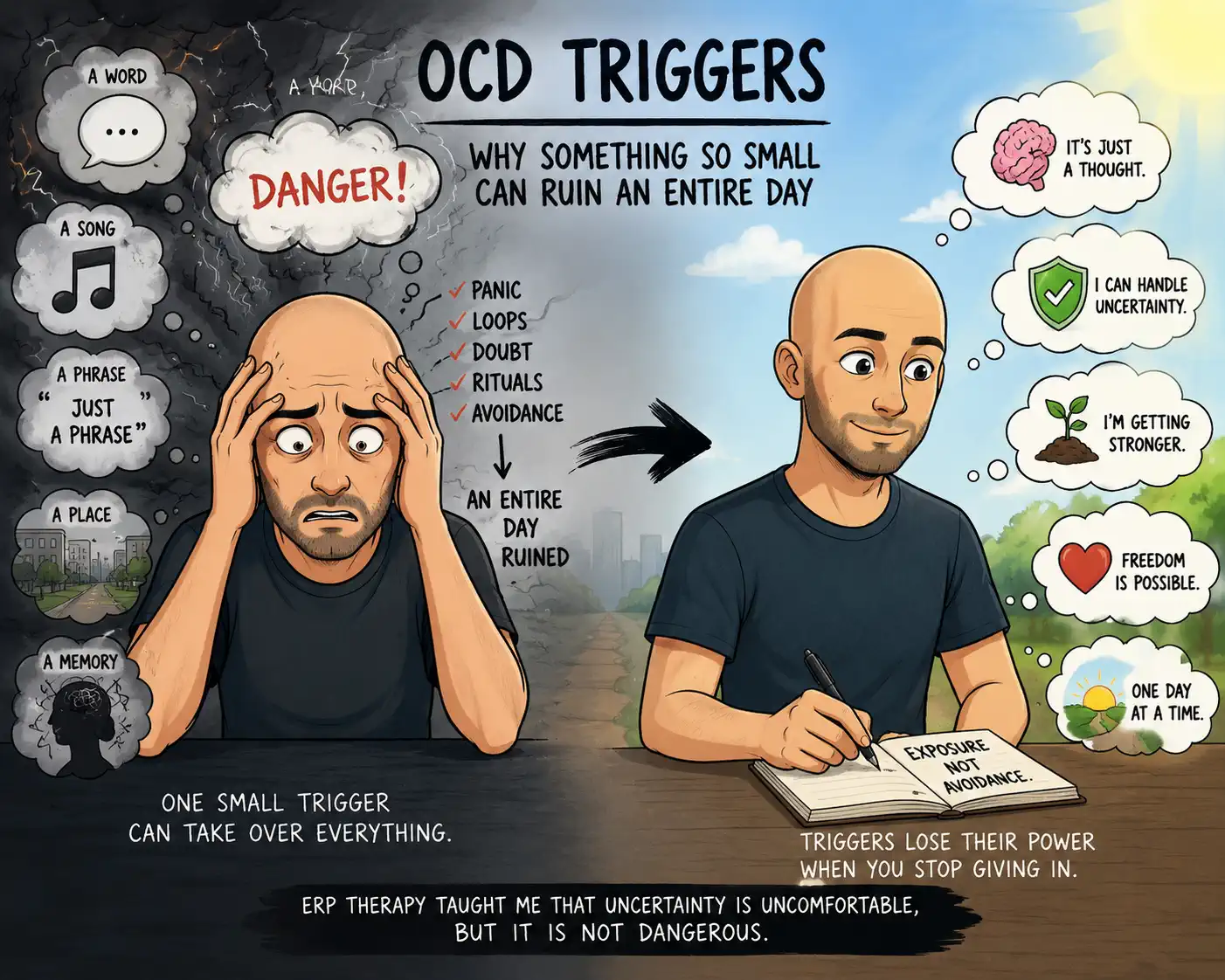
OCD Triggers: Why Something So Small Can Ruin an Entire Day
One of the hardest things to explain to someone who does not have OCD is what a trigger actually feels like.
Most people hear the word "trigger" and think someone is offended, upset, or angry about something. In OCD, that is usually not what people mean at all.
For me, a trigger feels more like a sudden alarm going off in my brain.
It can be a word, a phrase, a song, an image, a place, a memory, or even a random object. Most people would look at these things and see absolutely nothing unusual. My OCD, however, sees danger.
The strange thing is that the danger is often impossible to explain.
If someone asked me why a certain word triggered me, I often could not give a logical answer. I simply knew that when I saw it, I felt panic. My heart would race. My thoughts would begin looping. My entire focus would shift toward fixing whatever my OCD believed had gone wrong.
At my worst, a single trigger could ruin an entire day.
I remember periods of my life when seeing a certain word would make me believe that everything connected to that day had become contaminated. If I bought something after seeing the trigger, my OCD would tell me the item was contaminated too. Sometimes I would avoid using it. Sometimes I would get rid of it entirely.
Looking back, it sounds unbelievable.
At the time, it felt completely real.
That is one of the most frustrating things about OCD. You can know something makes no logical sense and still feel trapped by it.
Triggers Are Not Always Obvious
Triggers are not limited to words.
There were songs that triggered me. Certain phrases. Certain names. Sometimes even locations.
One of the reasons I spent so much time avoiding things was because I was constantly trying to prevent triggers from happening in the first place.
I would wear earphones in stores to avoid hearing music. I would avoid certain places. I would avoid certain conversations. I would structure entire days around trying not to encounter things that might trigger my OCD.
The problem was that avoidance never worked for long.
The more I avoided triggers, the stronger they became.
A trigger that started small would slowly grow larger and larger until it felt impossible to escape.
The Trigger Was Not the Real Problem
Eventually I realized something important.
The trigger was not the real problem.
My reaction to the trigger was the problem.
That was a difficult lesson to learn.
For years I believed that if I could just avoid enough triggers, I would finally be okay.
Instead, my world kept getting smaller.
I avoided one thing. Then another. Then another.
Before long, I was spending more time managing OCD than living my life.
Facing Triggers Through ERP
The turning point came when I began Exposure and Response Prevention therapy, commonly known as ERP.
I hated ERP at first. Everything about it felt wrong.
My therapist asked me to intentionally expose myself to things that triggered me. These were the exact things I had spent years trying to avoid.
One of the exercises involved writing down triggering words in a notebook every day.
My OCD thought this was a terrible idea.
If seeing a trigger accidentally was bad, then writing it down intentionally should have been even worse. At least that is what OCD told me.
Something interesting happened though.
Nothing happened.
The disasters OCD predicted never arrived. The bad luck never appeared. The contamination never spread. The feared outcome never came true.
Day after day I exposed myself to these triggers, and life continued normally.
Not only that, but the fear slowly began to fade.
The first few days were difficult. The first week was uncomfortable. Eventually many of the triggers that once controlled my life became nothing more than ordinary words again.
I remember one particular word that used to completely ruin my day.
Today I can say it, read it, and hear it without feeling much of anything.
The word itself never changed.
My relationship with it changed.
OCD Gives Triggers Their Power
That realization taught me something important about OCD.
Triggers do not have power on their own.
OCD gives them power.
A word is just a word. A song is just a song. An object is just an object.
The fear comes from the meaning OCD attaches to those things.
Once I stopped treating triggers as dangerous, many of them slowly lost their hold over me.
Triggers Can Lose Their Power
That does not mean I never get triggered anymore.
I still do.
I have severe OCD and probably always will.
New triggers appear from time to time. New fears develop. New themes emerge. That is simply how OCD works.
The difference today is that I understand what is happening.
When I encounter a trigger now, I try to remind myself that I have been through this before.
I remember all the words, songs, phrases, and objects that once controlled my life but no longer do.
I remember all the times OCD promised disaster and was wrong.
Most importantly, I remember that fear is not evidence.
Just because something feels dangerous does not mean it is dangerous.
That lesson has given me more freedom than almost anything else I have learned in treatment.
If there is one thing I wish people understood about OCD triggers, it is this:
People with OCD are not weak. They are not overly sensitive. They are not choosing to react this way.
Their brains are attaching fear to things that most people would never think twice about.
The good news is that triggers can lose their power.
I have seen it happen in my own life many times.
Not overnight. Not without effort. But it can happen.
And every trigger that loses its power is one more piece of freedom returned.