

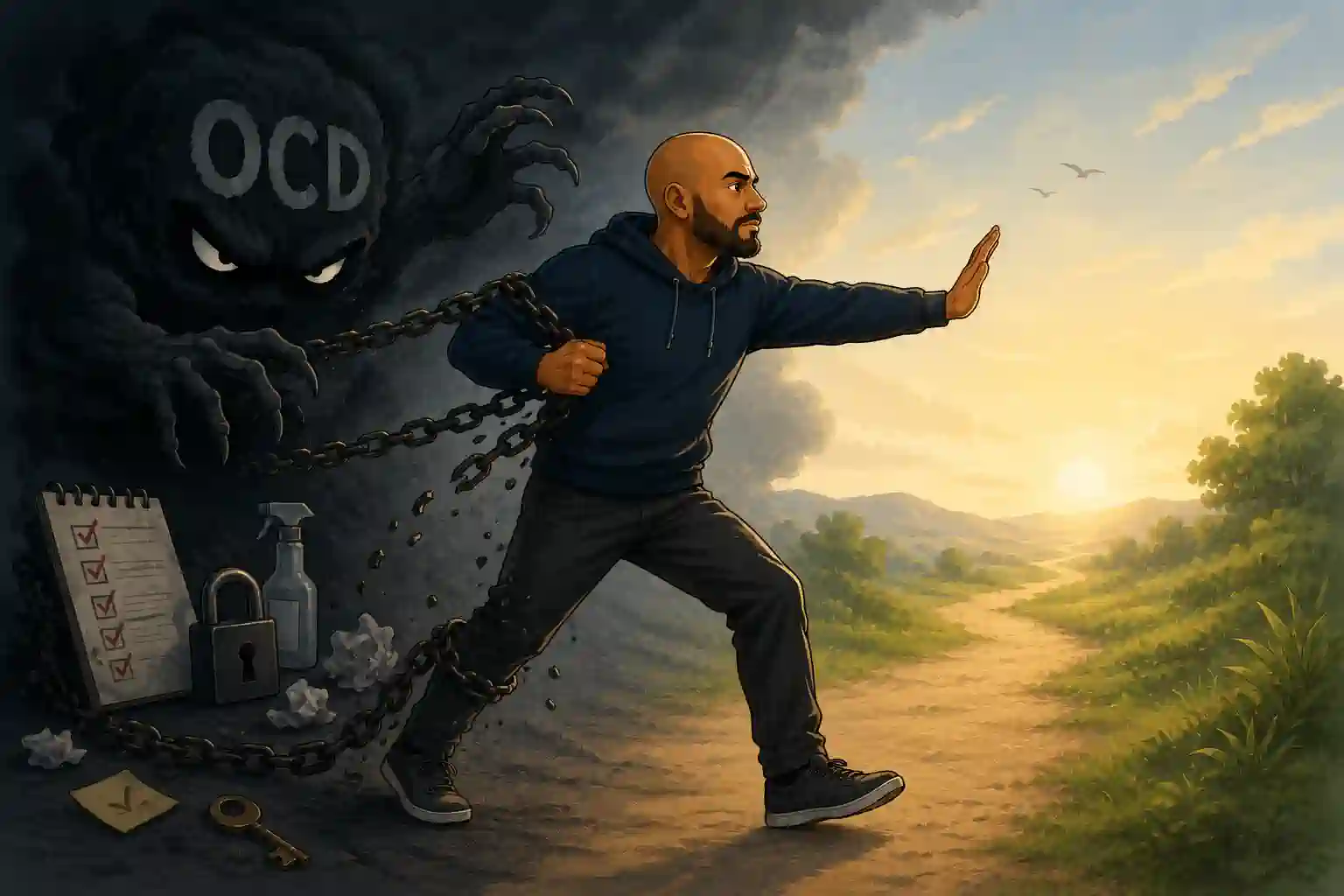
OCD Wants Control, Not Safety
For years, I believed my OCD was trying to protect me.
That sounds reasonable at first. After all, OCD constantly warns you about danger. It tells you to check one more time, repeat one more ritual, avoid one more place, or solve one more uncertainty. It feels like it is trying to keep you safe.
The longer I lived with OCD, however, the more I realized something important.
OCD does not actually want safety.
It wants control.
If It Wanted Safety, It Would Eventually Stop
This was the question that changed how I looked at my OCD.
If OCD truly wanted to protect me, why did it never tell me I was finally safe?
Why did one ritual become two?
Why did one trigger become twenty?
Why did one avoided road become an entire list of places I could no longer visit?
A disorder focused on safety would eventually say, "You're okay now."
OCD almost never says that.
Instead, it simply moves the goalpost.
Control Feels Like Safety
The difficult part is that control often feels like safety.
If I performed the ritual correctly, my anxiety dropped.
If I avoided the trigger, I felt relief.
If I repeated the compulsion one more time, my mind became quieter—for a little while.
I mistook that temporary relief for proof that OCD had protected me.
Looking back, I realize it was only giving me a brief reward for obeying it.
The anxiety went away.
The rules stayed.
My World Became Smaller
One of the clearest signs that OCD wanted control instead of safety was how much of my life it eventually controlled.
It started with individual triggers.
Then certain words.
Then songs.
Then roads.
Then stores.
Eventually, even entire areas became difficult.
My world did not become safer.
It became smaller.
Every new rule gave OCD another piece of my life.
The Rules Never Ended
That is another clue.
Control never reaches a finish line.
OCD always wants one more guarantee.
One more check.
One more reassurance.
One more ritual.
One more attempt to remove uncertainty.
The problem is that uncertainty is part of being human.
No amount of rituals can remove it forever.
ERP Took Control Away From OCD
Exposure and Response Prevention therapy did something that felt completely backwards.
Instead of giving OCD more control, it asked me to give it less.
It asked me to leave rituals unfinished.
It asked me to stop checking.
It asked me to continue my day while uncertainty was still present.
At first, that felt reckless.
In reality, it was the first time I was taking control back.
Real Life Is Uncertain
One lesson I continue learning is that nobody gets complete certainty.
People without OCD live with uncertainty every day.
They simply do not spend hours trying to eliminate it.
OCD convinced me that certainty was achievable if I just worked hard enough.
It never was.
The finish line kept moving.
What I Remind Myself Today
When OCD tells me to perform another ritual, I try to ask myself one question.
Is this actually making me safer?
Or is it simply giving OCD more control over my life?
Most of the time, I already know the answer.
Safety is not measured by how many compulsions I complete.
Safety is not measured by how much certainty I can create.
Recovery begins when I stop trying to control every possible outcome.
Ironically, the more I let go of control, the more freedom I find.
That has been one of the hardest lessons OCD has ever taught me.
And it has also been one of the most valuable.
This article reflects my personal experience living with OCD and is not a substitute for professional medical or psychological advice.