

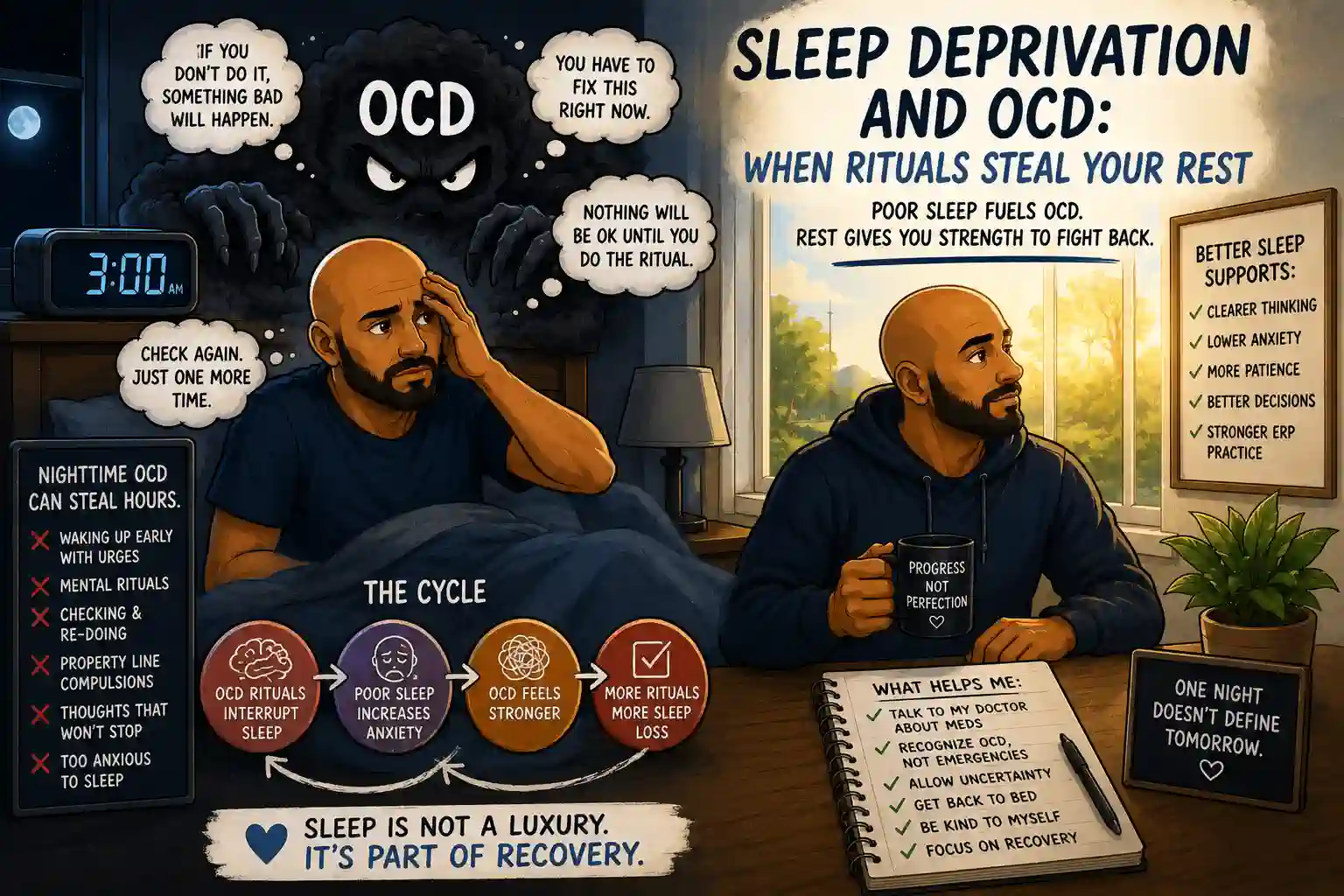
Sleep Deprivation and OCD: When Rituals Steal Your Rest
Sleep deprivation can make almost everything harder.
It makes thinking harder. It makes emotions harder to control. It makes anxiety feel louder. And for me, it can make OCD much harder to resist.
There are different reasons sleep can become a problem with OCD. Sometimes medication can affect sleep. Sometimes anxiety keeps the mind active. Sometimes compulsions interrupt the night completely.
I have experienced all of that.
When Medication Affects Sleep
Some psychiatric medications can affect sleep, especially when starting them or changing doses.
For example, aripiprazole can sometimes cause insomnia, restlessness, or an activating feeling in some people. For me, this was noticeable early on. I felt more energized, and my sleep became shorter than usual.
That does not mean the medication is bad or that it will affect everyone the same way. It simply means sleep changes are something worth paying attention to and discussing with a doctor.
In my case, moving medication timing to the morning helped some, but I still had to give my body time to adjust.
When OCD Wakes You Up
Medication is not the only issue.
OCD itself can steal sleep.
There have been nights when I woke up around 3 AM with the urge to do rituals. My brain would tell me something had to be fixed immediately. A thought needed to be corrected. A ritual needed to be done. A property line needed to be crossed correctly.
That is one of the cruelest parts of OCD.
It does not care that you are tired.
It does not care that you need sleep.
It does not care that tomorrow will be harder if you obey it tonight.
It only cares about getting the compulsion completed.
Rituals Can Destroy a Sleep Schedule
A ritual may start as something small.
One thought.
One check.
One correction.
One attempt to feel safe before going back to bed.
But OCD rarely stops at one.
One ritual becomes another. Then another. Then suddenly the night is gone.
Even if I eventually get back to sleep, the damage is already done. The next day I wake up tired, irritable, foggy, and more vulnerable to anxiety.
That creates a bad cycle.
OCD interrupts sleep. Poor sleep makes OCD harder to resist. Then OCD becomes louder again.
Why Poor Sleep Makes OCD Feel Stronger
When I am well-rested, I have more ability to resist compulsions.
I can think more clearly. I can tolerate anxiety longer. I can remind myself that a trigger is just a trigger and that I do not need to perform a ritual.
When I am sleep deprived, everything feels harder.
The same trigger feels more serious.
The same intrusive thought feels more convincing.
The same compulsion feels harder to resist.
That does not mean the fear is more true. It means my brain has less energy to fight back.
Sleep Is Not a Cure, But It Matters
I do not believe sleep alone cures OCD.
If that were true, anyone with OCD could simply sleep more and recover. It is not that simple.
But sleep does matter.
Good sleep gives me a stronger foundation. Bad sleep weakens that foundation.
ERP, medication, and daily choices are still the main tools for me. But without sleep, those tools become harder to use.
What I Try to Do
I am still working on this, so I do not want to pretend I have mastered sleep.
But there are a few things I try to remember.
If medication is affecting my sleep, I discuss it with my doctor instead of randomly changing it myself.
If OCD wakes me up, I try to recognize it as OCD instead of treating the ritual as an emergency.
If I lose sleep, I try not to turn the next day into another disaster story.
One bad night does not mean everything is ruined.
It means I had a bad night.
The Night Is Not the Time to Obey OCD
One lesson I am learning is that nighttime OCD often feels more convincing because I am tired.
At 3 AM, my brain is not at its best.
That is exactly why I have to be careful about obeying OCD during those hours.
OCD will say the ritual is urgent.
It will say I cannot go back to sleep until I fix it.
It will say tomorrow depends on what I do right now.
But I have heard that story before.
Most of the time, the best thing I can do is let the uncertainty exist and return to bed.
Not because it feels easy.
Because sleep is part of recovery too.
This article is based on my personal experience and is not medical advice. If OCD, insomnia, or medication side effects are affecting your sleep, speak with a qualified healthcare professional.