

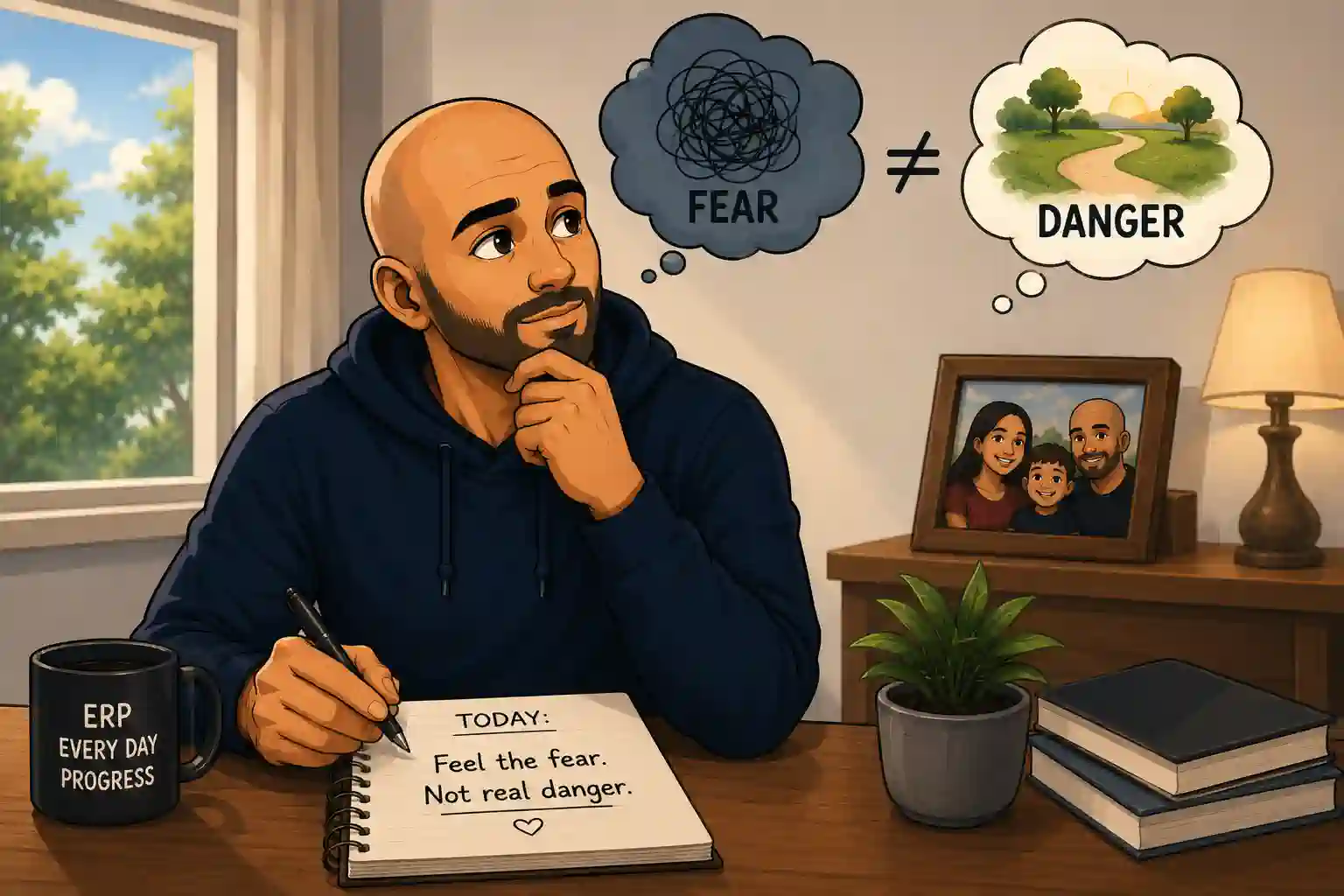
The Difference Between Fear and Danger
There was a time when I believed fear and danger were the same thing.
If my heart was racing, there must be danger. If my anxiety reached a ten out of ten, something terrible must be about to happen.
If OCD told me not to touch something, buy something, cross a property line, or even hear a certain word, I assumed there had to be a good reason.
After all, why would my brain react so strongly if there was not real danger?
That question kept me trapped for years.
Fear Is a Feeling. Danger Is Reality.
One of the biggest lessons I have learned through treatment is that fear and danger are not the same thing.
Fear is an emotion.
Danger is an actual threat.
Sometimes they occur together. If a car is speeding toward you, fear is appropriate because there is genuine danger.
But OCD does something different.
It creates fear without creating danger.
That distinction changed everything for me.
OCD Makes Everything Feel Important
One thing OCD does remarkably well is convince you that whatever you are experiencing right now deserves your complete attention.
The trigger feels important. The intrusive thought feels important. The uncertainty feels important. The ritual feels necessary.
The anxiety feels like proof that something terrible is about to happen.
But feeling afraid does not mean something is actually dangerous.
My Experience With Magical Thinking
Much of my OCD involves magical thinking and what I personally describe as metaphysical contamination.
For example, a certain word might make me believe something I bought that day had somehow become contaminated or cursed.
Logically, I knew words do not possess that kind of power.
Emotionally, my brain reacted as if they did.
My heart would race. My stomach would tighten. My mind would immediately begin searching for ways to fix the situation.
Looking back, I realize something important.
The fear was real.
The danger was not.
The Brain Does Not Always Tell the Truth
This was difficult for me to accept.
I always assumed my brain was warning me about something important.
Sometimes it is.
Sometimes it is not.
OCD is a disorder that often mislabels ordinary situations as emergencies.
A random word becomes an emergency. A coincidence becomes an emergency. Buying groceries becomes an emergency. Walking across a property line becomes an emergency.
The brain sounds the alarm even when there is no fire.
That does not mean the alarm feels fake.
The anxiety is absolutely real.
The problem is that the alarm is being triggered by something that is not actually dangerous.
Why Compulsions Feel Like They Work
If there is no danger, why do compulsions seem helpful?
Because they reduce fear.
That is an important distinction.
They reduce fear.
They do not remove danger.
When I performed a ritual, my anxiety usually dropped.
For years I interpreted that as evidence that the ritual had worked.
Today I see it differently.
The ritual did not prevent disaster.
It temporarily calmed my nervous system.
Those are two completely different things.
Unfortunately, every time I obeyed OCD, I accidentally taught my brain that the false alarm had been worth listening to.
That kept the cycle alive.
ERP Changed My Perspective
Exposure and Response Prevention taught me something I never thought possible.
You can feel afraid without being in danger.
At first that idea sounded impossible.
How could I sit with all of that anxiety without fixing it?
But every successful exposure slowly taught my brain a different lesson.
The fear eventually came down on its own.
Not because I performed a ritual.
Not because I solved the obsession.
Not because I gained certainty.
It came down because anxiety naturally rises and falls when we stop feeding it.
Looking Back
When I look back over the last several years, I realize how many decisions were based on fear instead of danger.
I avoided places. I avoided words. I avoided songs. I repeated rituals. I delayed purchases. I postponed important parts of life.
Not because I was actually in danger, but because OCD convinced me I was.
That realization is both frustrating and encouraging.
Frustrating because of how much time OCD stole from me.
Encouraging because it reminds me that recovery is possible.
If fear does not automatically mean danger, then I do not have to obey every fear that appears.
What I Remind Myself Today
I still have OCD.
I still experience intrusive thoughts.
I still have days when anxiety feels overwhelming.
But today I try to ask myself a different question.
Instead of asking, “Why am I so afraid?” I ask, “Am I actually in danger?”
Those are not always the same question.
Most of the time, the answer is no.
That does not make the fear disappear immediately.
But it reminds me that I do not have to treat every feeling like a fact.
Fear is part of OCD.
Danger is part of life.
Learning the difference has been one of the most important lessons in my recovery.
And every time I practice ERP, I remind myself of something simple.
Just because OCD makes something feel dangerous does not mean it actually is.