

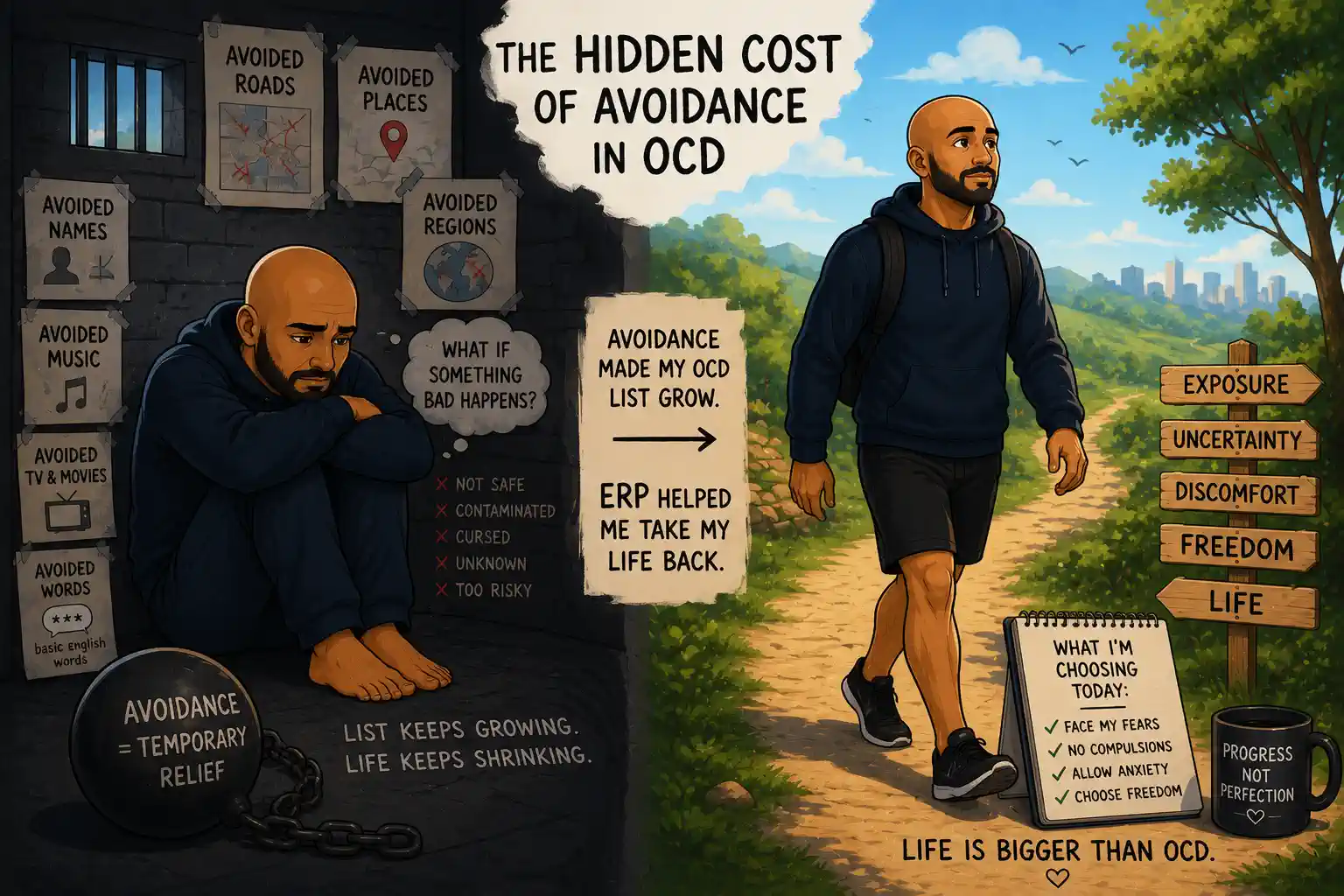
The Hidden Cost of Avoidance in OCD
Avoidance feels like safety in the beginning.
That is why it is so easy to fall into. Something triggers your OCD, your anxiety rises, and you avoid it. For a moment, you feel better.
The problem is that avoidance does not remove OCD. It teaches OCD to grow.
I learned this the hard way.
Every time I avoided something, my OCD list became longer. It started with certain triggers, but then it spread. Roads. Places. Stores. Music. Names. Basic English words. Even entire regions could become connected to fear in my mind.
What looked like one small avoidance slowly became a prison.
Avoidance Made My World Smaller
At first, avoiding a trigger seemed reasonable.
If a certain word caused panic, why not avoid it?
If a certain road felt contaminated, why not take another road?
If a certain song triggered my OCD, why not wear headphones or leave the store?
Each decision looked small by itself.
But OCD does not stop with one small rule.
One avoided word became a list of avoided words. One avoided place became a list of avoided places. One avoided road became a larger map of areas I no longer wanted to enter.
Eventually, avoidance started choosing where I could go, what I could watch, what I could listen to, and what words I could tolerate.
The List Kept Growing
That is the hidden cost of avoidance.
It does not stay contained.
OCD takes the relief from avoiding one thing and uses it as evidence that the thing was dangerous. Then it looks for the next thing.
A name becomes unsafe.
A song becomes unsafe.
A road becomes unsafe.
A city becomes unsafe.
A normal word becomes unsafe.
Before long, you are not just avoiding one trigger anymore. You are arranging your life around a growing list of rules.
Becoming a Prisoner
I do not say this lightly, but avoidance made me feel like a prisoner.
Not always physically, but mentally.
I could be standing in a normal place and still feel trapped because OCD had already decided what was allowed and what was forbidden.
I could not freely watch what I wanted.
I could not freely listen to music.
I could not freely go certain places.
I could not even freely hear or read certain words without my brain reacting as if something terrible had happened.
That is not freedom.
That is OCD building walls.
Avoidance Gives Temporary Relief
The reason avoidance is so tempting is because it works in the short term.
If I avoid the trigger, the anxiety drops.
If I stay away from the place, I feel safer.
If I skip the song, I avoid the panic.
But that relief comes with a price.
Every time I avoided something, I was teaching my brain that avoidance was necessary.
I was teaching my OCD that the trigger had power.
I was teaching myself that I could not handle it.
That is how the prison grew.
ERP Taught Me the Opposite
Exposure and Response Prevention therapy taught me that the way out was not more avoidance.
The way out was facing the things OCD told me to avoid.
That did not mean doing everything all at once or throwing myself into the hardest exposure immediately. ERP should be planned carefully, ideally with a qualified therapist, especially when OCD is severe.
But the lesson was clear.
The more I avoided, the more OCD grew.
The more I faced triggers without performing compulsions, the more my life slowly opened back up.
What I Learned
Avoidance promises safety, but it usually takes freedom.
It tells you that skipping one word, one road, one place, or one song is not a big deal.
But OCD rarely stops there.
It keeps expanding the list until life becomes smaller and smaller.
I still struggle with avoidance sometimes. I am not perfect. But today I understand the cost much better.
Every time I avoid something because of OCD, I have to ask myself what I am teaching my brain.
Am I teaching it that I am safe only if I obey OCD?
Or am I teaching it that I can feel anxiety and still live my life?
That question matters.
Because avoidance may feel like safety for a moment, but recovery is what gives life back.