

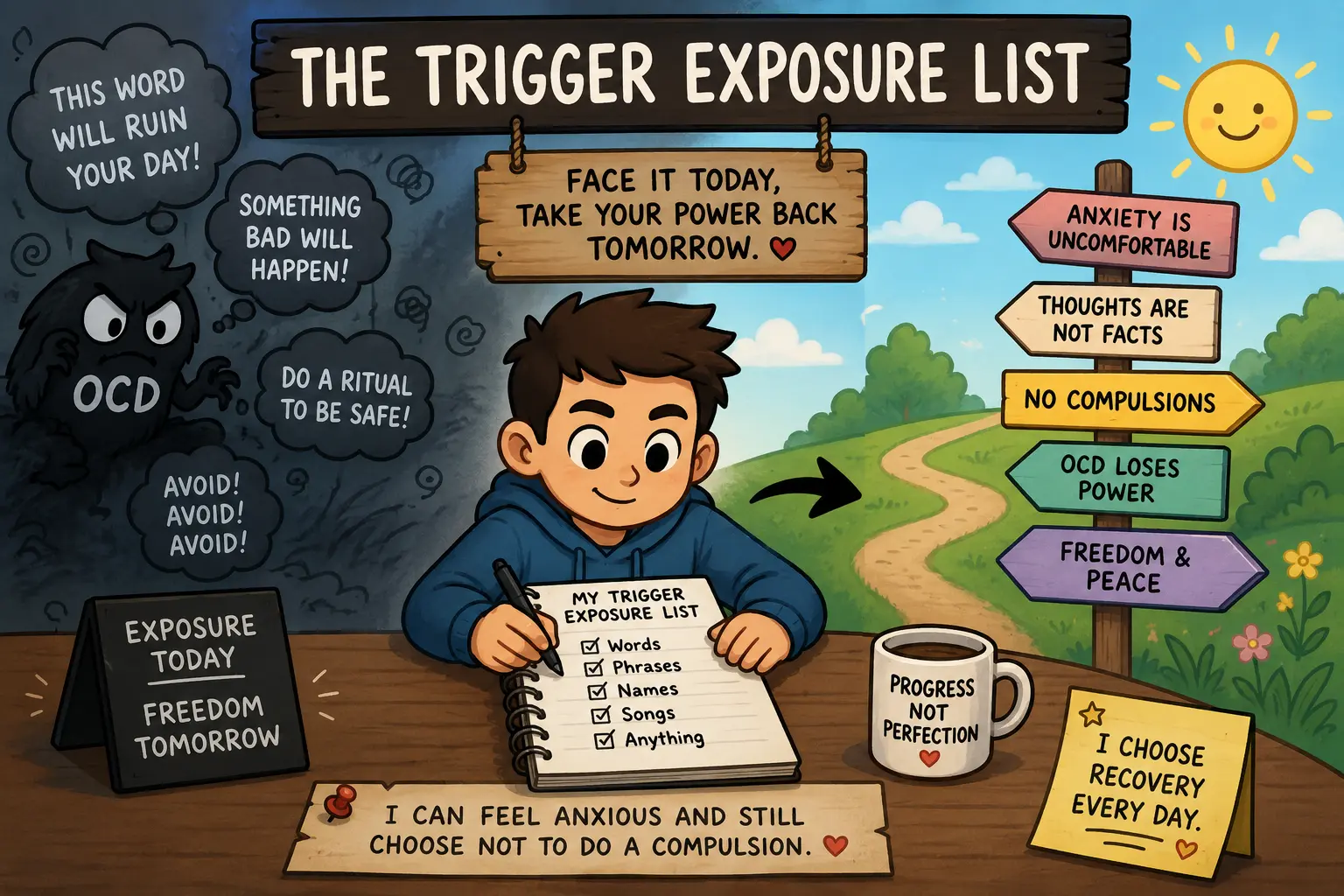
The OCD Trigger Exposure List
This article describes my personal experience with ERP and OCD treatment. It is not medical advice. ERP exercises should ideally be planned with a qualified mental health professional, as every person's OCD is different.
This is one of the methods that helped me overcome dozens of triggering words over the years.
Before I begin, I want to clarify something. When people with OCD talk about being "triggered," they are usually not talking about being offended or upset. In OCD, a trigger can cause intense anxiety, panic, racing thoughts, compulsive urges, and the overwhelming feeling that something bad is about to happen.
A trigger can be almost anything. A word, a phrase, a song, a name, an image, a place, or even an object.
For me, certain words were so powerful that if I saw one on a particular day, I would consider the entire day cursed. If I bought something that day, my OCD would tell me it was contaminated by the trigger. At my worst, I believed I would need to get rid of anything I purchased after encountering one of these words.
It sounds irrational now, but at the time it felt completely real.
The Exercise My Therapist Taught Me
One of the first ERP exercises my therapist taught me involved intentionally exposing myself to triggering words.
Every morning, I would take a notebook and write down the words, phrases, and other triggers that caused me anxiety.
The idea was simple. If my OCD believed a word could ruin my day, then I would intentionally expose myself to that word at the beginning of the day under the guidance of the method my therapist had given me.
Instead of avoiding the trigger, I practiced allowing it to exist without trying to neutralize it through rituals.
My OCD hated this.
The goal was not to make the anxiety disappear immediately. The goal was to teach my brain that I could experience the trigger without performing compulsions afterward.
Over time, my brain slowly learned that the feared consequences never happened.
Music Exposures
Words were not my only triggers.
Certain songs could trigger my OCD as well.
There was a period of my life when I wore earphones in stores just so I would not hear music that might trigger me. If I heard the wrong song, I would often abandon what I was doing and leave.
Eventually, with the same ERP approach, I began practicing exposure with music too.
I would intentionally listen to songs that triggered me and try to continue without performing rituals.
The first few days were difficult.
But something interesting happened.
After enough repetition, the fear started to fade.
In my experience, the anxiety became more manageable over time. Some triggers lost their power much faster than I expected, while others took longer.
Consistency Matters
One of the biggest lessons I learned is that ERP works best when practiced consistently and safely.
Doing an exposure once can be helpful. Doing it repeatedly, in a planned way, is what helped create lasting change for me.
Every time I wrote down a triggering word, listened to a triggering song, or faced a feared situation without performing compulsions, I was teaching my brain something new.
I was teaching it that anxiety is uncomfortable but not dangerous.
I was teaching it that thoughts are not facts.
Most importantly, I was teaching it that OCD's predictions were often wrong.
The Question That Changed Everything
At some point I began asking myself a simple question.
If I expose myself to these triggers repeatedly and nothing bad happens, why am I still treating them like they have power?
That question became difficult for OCD to answer.
The evidence was right in front of me.
I had deliberately exposed myself to the things I feared, and life continued as normal.
The feared outcomes never appeared.
Questioning OCD's Rules
OCD survives by convincing us that its rules must be followed.
For me, recovery began when I started questioning those rules instead of automatically obeying them.
It was not about forcing myself to feel calm. It was about learning that I could feel anxious and still choose not to perform a compulsion.
I have used this approach to overcome many triggering words, phrases, and songs throughout my life.
That does not mean OCD never returns with new fears. It often does.
But every successful exposure gives me confidence that I can handle the next one as well.
Years ago, one of the words that could completely ruin my day was the word "adventure."
Today, it is just another word.
That is what facing fear through treatment has done for me.