

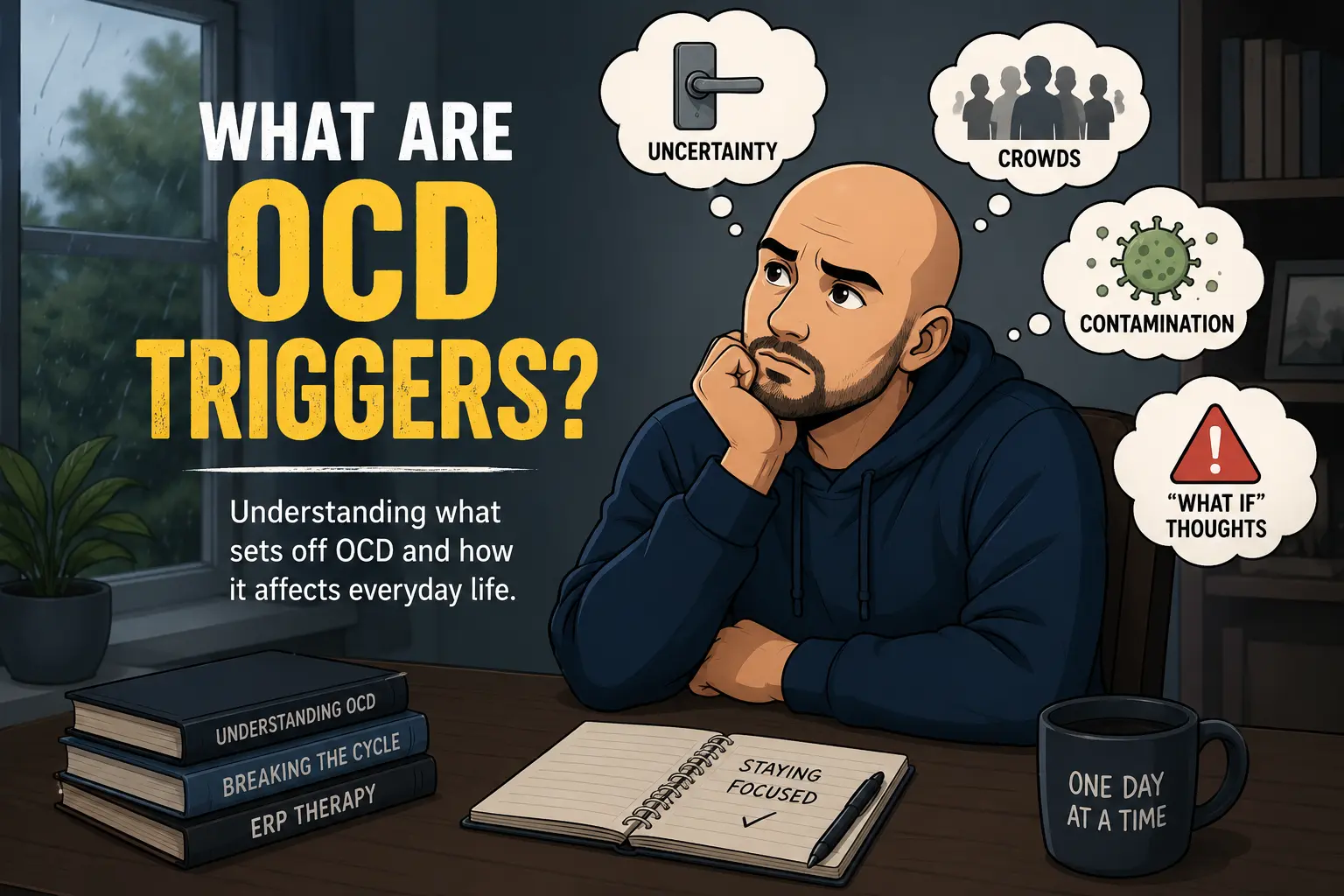
What Are OCD Triggers?
For most people, a word is just a word. A song is just a song. A picture is just a picture.
For someone with obsessive-compulsive disorder, any of those things can become attached to fear.
If you spend time in the OCD community, you will often hear people talk about "triggers." Unfortunately, many people misunderstand what that word means.
When someone with OCD says they were triggered, they are not talking about being offended, angry, or upset. In the OCD world, a trigger is something that activates intense anxiety, fear, obsessive thoughts, or compulsive urges.
A trigger can be almost anything depending on the person and their OCD theme.
How OCD Triggers Work
Let's use a simple example.
Imagine the word "lamp" became connected to fear in someone's mind. Over time, their brain builds a strong association between that word and anxiety. Eventually, hearing the word alone may create an immediate physical reaction. Their heart races, their muscles tense, and intrusive thoughts begin flooding their mind.
For some people, a trigger can feel like a shockwave moving through their body. Others may experience panic, dread, or an overwhelming feeling that something terrible is about to happen.
For me personally, triggers often made me feel like my entire day was ruined or "cursed." Sometimes it felt like the day could not reset until I went to sleep and woke up the next morning.
Years ago, I probably had hundreds of triggers. Through medication and Exposure and Response Prevention (ERP) therapy, I have reduced that number dramatically.
But triggers are not limited to words.
Music, images, phrases, locations, objects, people, memories, sounds, and even certain thoughts can become triggers. OCD does not care what the trigger is. It only cares that fear has become attached to it.
Examples From My Own OCD
Over the years, my OCD attached fear to many different things. Certain words would trigger intense anxiety. Some songs became connected to obsessive fears. Images could trigger rituals. Even crossing a property line could set off a chain of compulsions that lasted for hours.
To someone without OCD, these things may seem unrelated. To someone with OCD, however, the brain has created a powerful connection between the trigger and fear.
That connection feels completely real in the moment, even when you know logically that it makes no sense.
Why Understanding Matters
I think people should be more understanding when someone says they have been triggered by their OCD.
That person is not being weak, dramatic, or overly sensitive. Something is happening inside their brain that feels very real and often produces intense anxiety.
Yes, ERP therapy is considered the gold standard treatment for OCD. Yes, learning to face triggers is an important part of recovery.
But not everyone is at the same stage of treatment.
Some triggers are much stronger than others. Some people are just beginning therapy. Others may still be building the skills needed to face their fears. Recovery is a process, not a race.
If you know someone has a trigger they have not yet worked through, a little compassion can go a long way.
The Reality of Living With Triggers
I understand that the world does not revolve around my OCD, and I have never expected it to.
I cannot expect a store to turn off its music because a song triggers me. I cannot expect everyone around me to avoid certain words or topics.
Instead, many people with OCD adapt by avoiding situations they know will trigger them. They wear headphones in public places, avoid certain locations, or limit interactions that might expose them to specific triggers.
While avoidance may reduce anxiety temporarily, it often comes at a cost. Over time, avoidance can shrink a person's world and make OCD even stronger.
That is one of the saddest parts of severe OCD. Many people end up isolating themselves simply to avoid the constant fear and anxiety that triggers create.
Can OCD Triggers Be Overcome?
The good news is yes.
Through ERP therapy, medication, and consistent practice, many people can significantly reduce the power their triggers have over them.
I have personally overcome many triggers that once controlled my life. Today, I feel better than I have in years.
However, OCD is often a lifelong condition that requires ongoing management. As old triggers disappear, new ones may occasionally emerge. That is why it is important to continue practicing the skills learned through treatment.
Recovery is not about eliminating every trigger forever. It is about learning how to respond differently when triggers appear.
If you are constantly being triggered by your OCD, do not lose hope. Progress is possible. I have seen it in my own life, and I believe you can experience it too.
A trigger is not dangerous because of what it is. It feels dangerous because of what OCD tells us it means.