

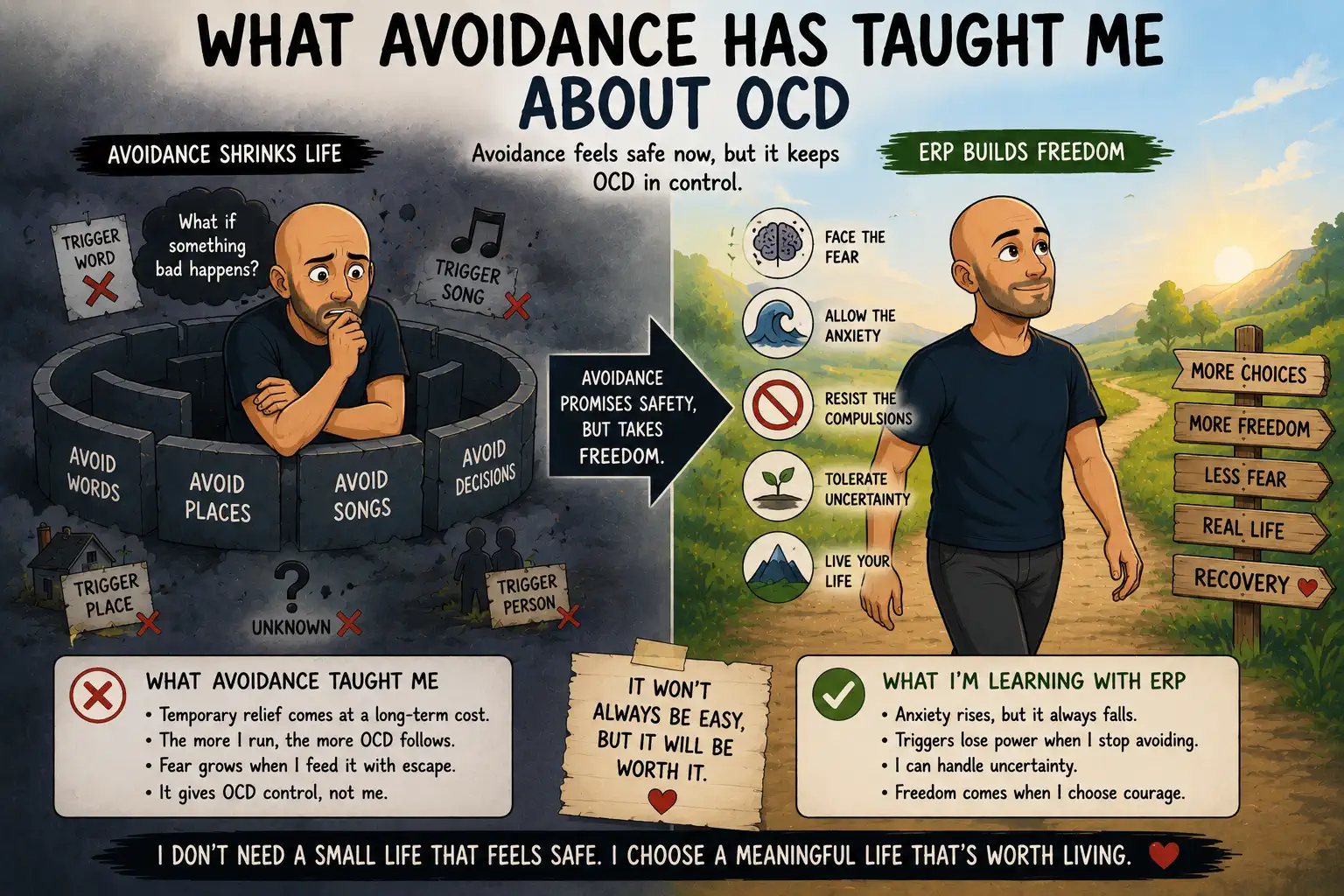
What Avoidance Has Taught Me About OCD
Avoidance feels like safety at first.
That is one of the biggest traps OCD creates. When something triggers anxiety, the easiest thing to do is avoid it. Avoid the word. Avoid the place. Avoid the person. Avoid the song. Avoid the decision. Avoid anything that might make OCD louder.
For a short time, avoidance works.
The anxiety drops. The panic fades. The day feels more manageable.
But the problem is that avoidance never actually solved my OCD. It only trained my brain to fear more things.
Avoidance Made My World Smaller
At my worst, I avoided words, songs, places, objects, conversations, property lines, and even entire areas because my OCD attached fear to them.
If something felt contaminated, cursed, or connected to a bad thought, I avoided it. If a place felt unsafe because of OCD, I stayed away. If a song or phrase triggered me, I tried not to hear it again.
Each avoidance felt small by itself.
But over time, all those small avoidances added up.
My world became smaller without me fully realizing it.
The Relief Was Temporary
Avoidance gave me relief, but only for a little while.
The more I avoided something, the more important it became in my mind. OCD treated the avoided thing as dangerous, and my brain learned to believe it.
That is the cruel part of OCD. Avoidance feels like protection, but it often strengthens the fear.
Instead of teaching my brain that I was safe, avoidance taught my brain that I had escaped danger.
OCD Always Wanted More
One thing avoidance taught me is that OCD is never satisfied.
If I avoided one trigger, OCD eventually found another. If I avoided one place, another place became suspicious. If I avoided one word, another word started to feel dangerous.
OCD kept moving the line.
That is when I realized avoidance was not giving me control. It was giving OCD control.
What ERP Taught Me Instead
Exposure and Response Prevention therapy taught me the opposite lesson.
Instead of avoiding fear, ERP taught me to face it in a planned and intentional way. Instead of performing rituals or running away, I had to allow the anxiety to exist without obeying OCD.
That was not easy.
But over time, I learned that anxiety can rise and fall without a ritual. I learned that triggers lose power when I stop treating them like threats.
Most importantly, I learned that avoidance was not protecting me. It was keeping me stuck.
What Avoidance Has Taught Me
Avoidance taught me that temporary relief can come at a long-term cost.
It taught me that the more I run from OCD, the more places it follows me.
It taught me that fear grows when I keep feeding it with escape.
And it taught me that freedom often begins when I stop letting OCD decide what I am allowed to do.
I still avoid things sometimes. I am not perfect. OCD is still part of my life.
But today I understand the trap much better.
Avoidance promises safety, but it usually takes freedom.
Facing fear is difficult, but it gives life back piece by piece.