

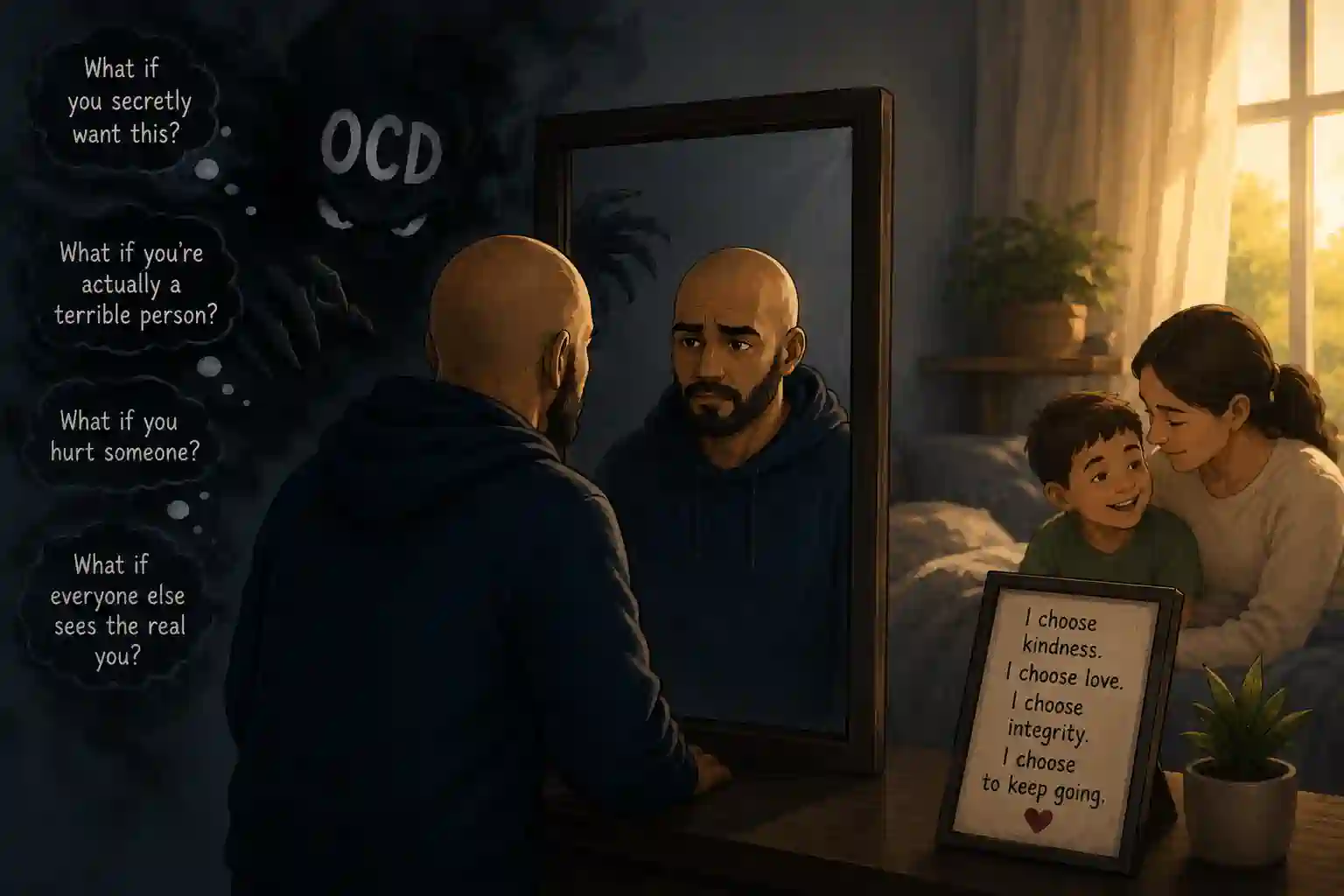
When OCD Makes You Feel Like a Bad Person
One of the most painful things OCD has ever done to me is make me question what kind of person I am.
Not because I had actually done something wrong, but because OCD convinced me that having a thought was somehow the same as committing an action.
If you have ever experienced this, I want you to know that you are not alone.
Many people with OCD struggle with intrusive thoughts that completely contradict who they really are.
Unfortunately, OCD has a way of turning those thoughts into accusations.
OCD Is Very Good at Making Accusations
OCD rarely begins by saying, "You are a good person."
Instead, it asks questions.
What if you secretly wanted that thought?
What if you are lying to yourself?
What if everyone else sees something you cannot?
What if you are actually a terrible person?
Those questions can feel incredibly convincing because OCD knows exactly where to attack.
It attacks the things that matter most.
If being a kind, honest, loving person is important to you, OCD may use those very values against you.
Thoughts Are Not Character
One of the biggest lessons I have learned is that thoughts are not character.
Everyone has strange, unwanted, and sometimes disturbing thoughts.
The difference is that people with OCD often become stuck on them.
We analyze them.
We replay them.
We ask what they mean.
We try to prove they are not true.
Ironically, the more we try to solve them, the stronger they become.
My OCD Was Not Trying to Tell Me the Truth
Looking back, I realize OCD was never trying to reveal some hidden truth about me.
It was trying to keep me uncertain.
Whether the theme involved magical thinking, contamination, or another obsession, the pattern was always the same.
OCD demanded certainty that I could never completely provide.
That uncertainty slowly turned into guilt.
And guilt slowly turned into self-doubt.
For a long time, I confused those feelings with evidence.
Today I know they were symptoms of OCD, not proof that I was a bad person.
Trying to Prove You Are Good Never Ends
One of the traps OCD sets is convincing you that you need to prove your character.
You replay conversations.
You examine your intentions.
You seek reassurance.
You apologize for things that never happened.
You mentally review every detail, hoping to finally feel certain.
Unfortunately, OCD almost never accepts the evidence.
No matter how much you review, it simply asks another question.
"But what if...?"
ERP Helped Me See the Difference
Exposure and Response Prevention therapy taught me something I desperately needed to learn.
I do not have to answer every accusation OCD makes.
I do not have to defend myself against every intrusive thought.
I do not have to prove that I am a good person every single day.
Instead, I can let the thought exist without treating it like evidence.
That felt impossible at first.
But over time, I discovered that refusing to argue with OCD weakened its grip far more than trying to win the argument.
Your Values Tell the Real Story
One thing that gives me comfort is remembering what OCD chooses to attack.
It attacks kindness because kindness matters to me.
It attacks my family because I love them.
It attacks my integrity because integrity is important to me.
The very fact that these thoughts cause so much distress says far more about my values than the thoughts themselves.
OCD mistakes caring deeply for evidence of danger.
It is wrong.
What I Remind Myself Today
I still have intrusive thoughts.
I still have days when OCD tries to convince me that I am someone I am not.
But today I remind myself that my character is not measured by the thoughts that enter my mind.
It is measured by how I choose to live.
I choose to love my family.
I choose kindness.
I choose honesty.
I choose to keep moving forward, even when OCD tells me I do not deserve to.
OCD may try to make me feel like a bad person.
That does not mean I am one.
And little by little, ERP has taught me that I no longer have to believe every accusation OCD makes.
This article reflects my personal experience living with OCD and is not a substitute for professional mental health care. If intrusive thoughts are affecting your life, consider speaking with a qualified mental health professional.