

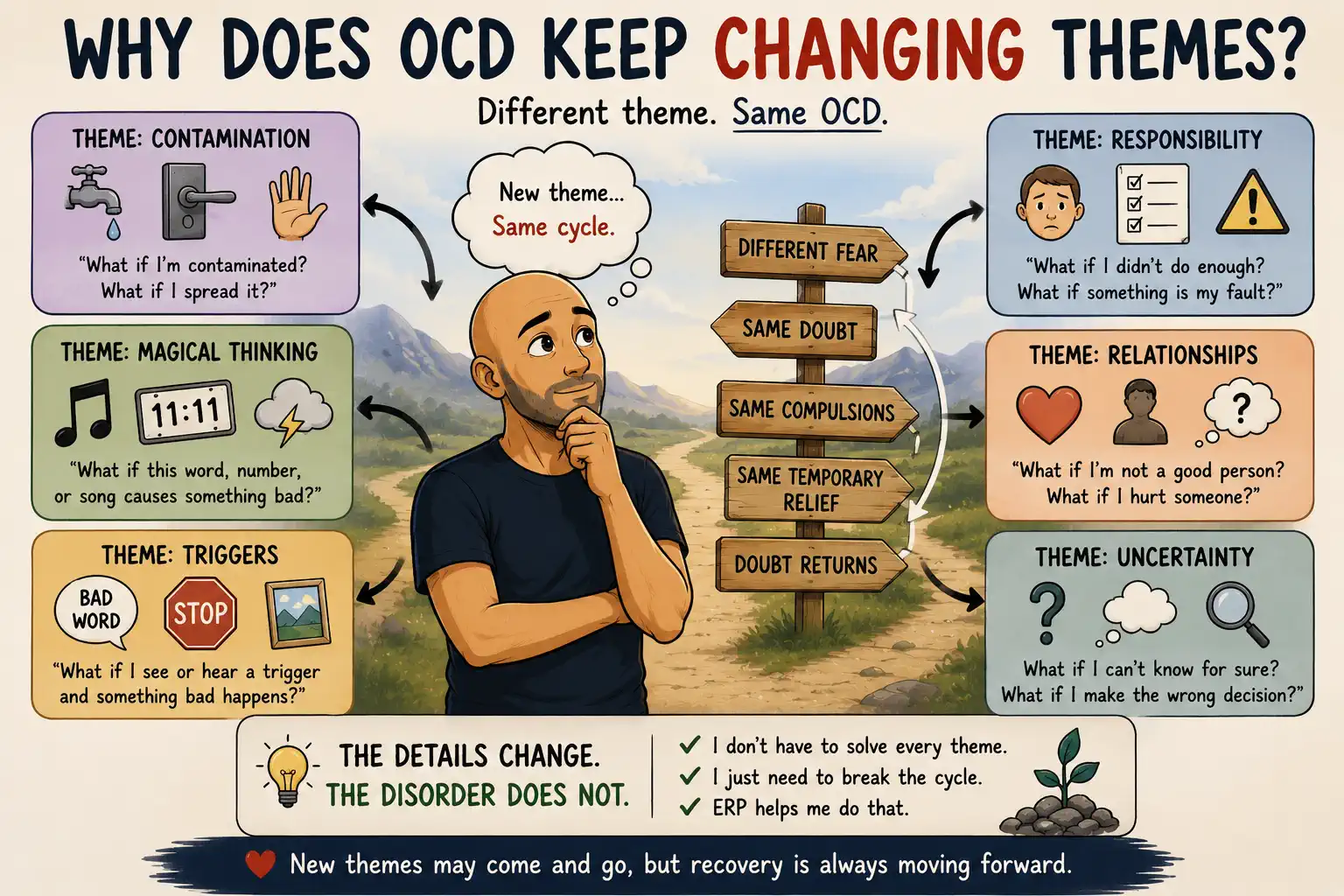
Why Does OCD Keep Changing Themes?
One of the most confusing things about OCD is that just when you think you have figured it out, it changes.
You finally start making progress against one fear, and suddenly another appears.
You overcome one trigger, and a new trigger takes its place.
You spend months fighting one obsession only to discover OCD has found an entirely different way to get your attention.
For years I thought each new theme was a completely separate problem.
I was wrong.
It Started With One Theme
Like many people with OCD, my symptoms did not stay the same throughout my life.
Different fears came and went. Different triggers appeared. Different rituals developed.
At one point I was dealing heavily with triggering words. Later it became metaphysical contamination. At another time it focused on property line rituals. Other fears appeared and disappeared along the way.
Every single theme felt unique.
Every single theme felt urgent.
Every single theme felt like the one I absolutely had to solve.
Looking back now, I can see that OCD was using different costumes while playing the same role.
The Theme Is Not the Problem
This was one of the hardest lessons for me to learn.
OCD wants you to focus on the theme.
It wants you to believe that the trigger, thought, object, word, song, or fear is the real issue.
But underneath all of those things is the same process.
Doubt.
Anxiety.
Compulsions.
Temporary relief.
Then doubt again.
Whether the theme involves contamination, magical thinking, health, relationships, religion, responsibility, or something else entirely, the cycle often looks remarkably similar.
The details change.
The pattern stays the same.
Why OCD Needs New Themes
One reason OCD changes themes is because recovery works.
That may sound strange, but hear me out.
When you begin challenging a fear through ERP, the brain slowly learns that the fear may not be as dangerous as OCD claimed.
The anxiety starts losing some of its power.
The rituals become less convincing.
The theme becomes harder for OCD to use.
So OCD often looks for another opening.
Another doubt.
Another uncertainty.
Another "what if?"
It is almost as if the disorder is trying to find a new doorway after the old one starts closing.
The Common Thread
For me, one common thread existed across nearly every OCD theme I have experienced.
Uncertainty.
Whether it involved a trigger, contamination, a ritual, or a thought, OCD always demanded certainty.
It wanted guarantees.
It wanted proof.
It wanted me to remove all doubt.
The problem is that certainty does not exist.
Not in OCD and not in life.
The more I chased certainty, the stronger OCD became.
The more I learned to tolerate uncertainty, the weaker the themes became.
What ERP Taught Me
ERP taught me something that I wish I had understood years earlier.
I do not have to fight every theme individually.
I need to fight the process that keeps creating them.
When OCD says, "What if?" I do not always need an answer.
When OCD creates doubt, I do not always need certainty.
When OCD demands a ritual, I do not always have to obey.
That approach works regardless of the theme.
The theme may change.
The strategy stays the same.
What I Remind Myself Today
Whenever a new OCD theme appears, I try to remember something important.
I have seen this before.
The details may be different, but the pattern is familiar.
OCD wants me to believe this theme is special.
It wants me to believe this fear is different from all the others.
But when I step back and look carefully, I usually find the same cycle underneath.
Doubt.
Anxiety.
Compulsions.
Temporary relief.
Then doubt again.
The theme changes.
The disorder does not.
And once I learned to recognize that pattern, new themes became a little less convincing and a little easier to challenge.