

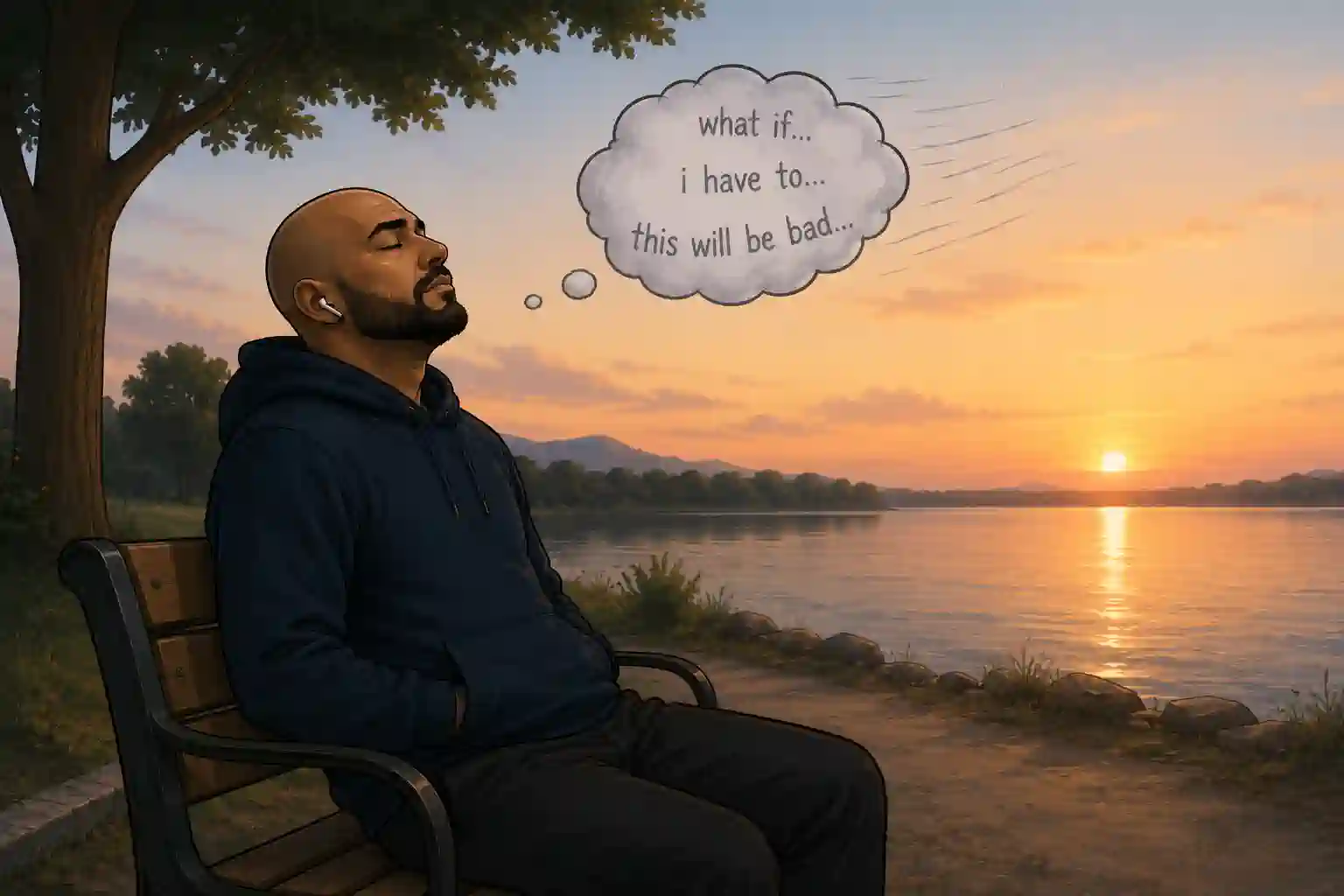
Why Doing Nothing Is Sometimes the Best Response to OCD
If someone had told me years ago that the best response to one of my biggest fears was to do absolutely nothing, I probably would have thought they were crazy.
Doing nothing felt irresponsible.
It felt dangerous.
It felt like I was taking a risk.
But after years of living with OCD and practicing Exposure and Response Prevention, also known as ERP, I have learned that sometimes doing nothing is exactly what recovery requires.
Not because I am ignoring a real problem.
Because I am refusing to solve a problem that OCD invented.
OCD Demands Action
One thing almost every OCD theme has in common is urgency.
OCD wants you to act immediately.
Do the ritual.
Check again.
Think about it longer.
Ask someone for reassurance.
Avoid the trigger.
Start over.
It creates the feeling that something must be done right now.
For me, that urgency often felt more convincing than the obsession itself.
I Used to Think Action Meant Safety
When my magical thinking OCD was at its worst, I believed every trigger required a response.
If I heard the wrong word, I needed a ritual.
If I saw the wrong logo, I needed to correct it.
If I had the wrong thought, I had to undo it somehow.
I spent years reacting to things that most people never noticed.
The strange part is that every action seemed to help.
At least for a few minutes.
Then the next trigger arrived.
Then the next ritual.
Then the next demand from OCD.
That is not real safety. That is a loop.
The Hardest Five Minutes
The first time I intentionally did nothing, my anxiety shot through the roof.
Everything inside me wanted to fix the situation.
My brain insisted I was making a mistake.
It told me I would regret it.
It promised something bad would happen.
So I waited.
I did nothing.
Those first few minutes can feel impossible.
You are not relaxed. You are not calm. You are not sitting there feeling brave and confident.
You are uncomfortable, anxious, and tempted to obey OCD.
But that is where the real work happens.
Doing nothing gives the brain a chance to learn that anxiety can exist without a ritual following it.
Doing Nothing Is Not Actually Doing Nothing
From the outside, it may look like you are not doing anything.
Inside, you may be doing some of the hardest work of your life.
You are resisting compulsions.
You are allowing uncertainty.
You are letting anxiety rise without escaping it.
You are refusing to ask for reassurance.
You are choosing not to review the thought for the hundredth time.
That is not weakness.
That is discipline.
Anxiety Does Not Stay at the Top Forever
Something surprising happened when I practiced this enough times.
The anxiety did not last forever.
It was uncomfortable.
Sometimes very uncomfortable.
But eventually it started coming down on its own.
I had always believed the ritual caused the relief.
Now I see it differently.
The ritual temporarily calmed me, but it also trained my brain to fear the trigger again next time.
When I resisted the compulsion, the anxiety still came down eventually, but without feeding the cycle.
That was one of the biggest lessons ERP ever taught me.
My Brain Hated It at First
Every new exposure felt like the wrong thing to do at first.
My OCD always claimed this trigger was different.
This word was different.
This situation was different.
This day was different.
This one actually needed a response.
But I had heard that story before.
OCD wants every new fear to feel special, because if it feels special, I am more likely to obey it.
After enough repetitions, many of those “special” fears became ordinary memories.
Real Problems and OCD Problems
This does not mean every problem in life should be ignored.
Real problems exist.
If there is a fire, you respond.
If your child needs help, you respond.
If something practical needs to be handled, you handle it.
But OCD problems are different.
They usually demand certainty instead of practical action.
They demand rituals instead of solutions.
They demand repetition instead of progress.
That is why I try to ask myself one question:
Is this a real problem, or is this OCD demanding a response?
It Gave My Brain a Chance to Learn
Every time I resisted a compulsion, my brain learned something new.
The trigger appeared.
I did nothing.
The feared outcome did not happen.
The anxiety eventually dropped.
Eventually my brain stopped treating many of those triggers like emergencies.
That did not happen after one exposure.
It happened after hundreds of small decisions.
One trigger at a time.
One resisted ritual at a time.
I Still Have to Practice It
I wish I could say I never struggle anymore.
That would not be true.
New triggers still appear.
New doubts still appear.
OCD still tries to convince me that this time is different.
But now I have something I did not have before.
Experience.
I have watched anxiety come down on its own too many times to ignore it.
I have watched OCD make predictions that never came true.
What I Remind Myself Today
Whenever OCD tells me I have to do something immediately, I try to pause.
If it is OCD, sometimes the strongest response I can make is no response at all.
Not because I do not care.
Because I refuse to feed the disorder that has already taken enough of my life.
Doing nothing used to feel like failure.
Today, I often see it as one of the bravest choices I can make.
Recovery is not about being perfect. Sometimes I still perform compulsions. Sometimes I still give in. But progress is responding differently more often than I used to.
Looking back, one of the biggest surprises in my recovery is that doing nothing accomplished more than all the rituals I ever performed.
My compulsions never solved OCD.
They kept it alive.
The moments when I chose to sit with uncertainty became the moments my brain finally started to change.
Sometimes the strongest thing you can do is nothing at all.