

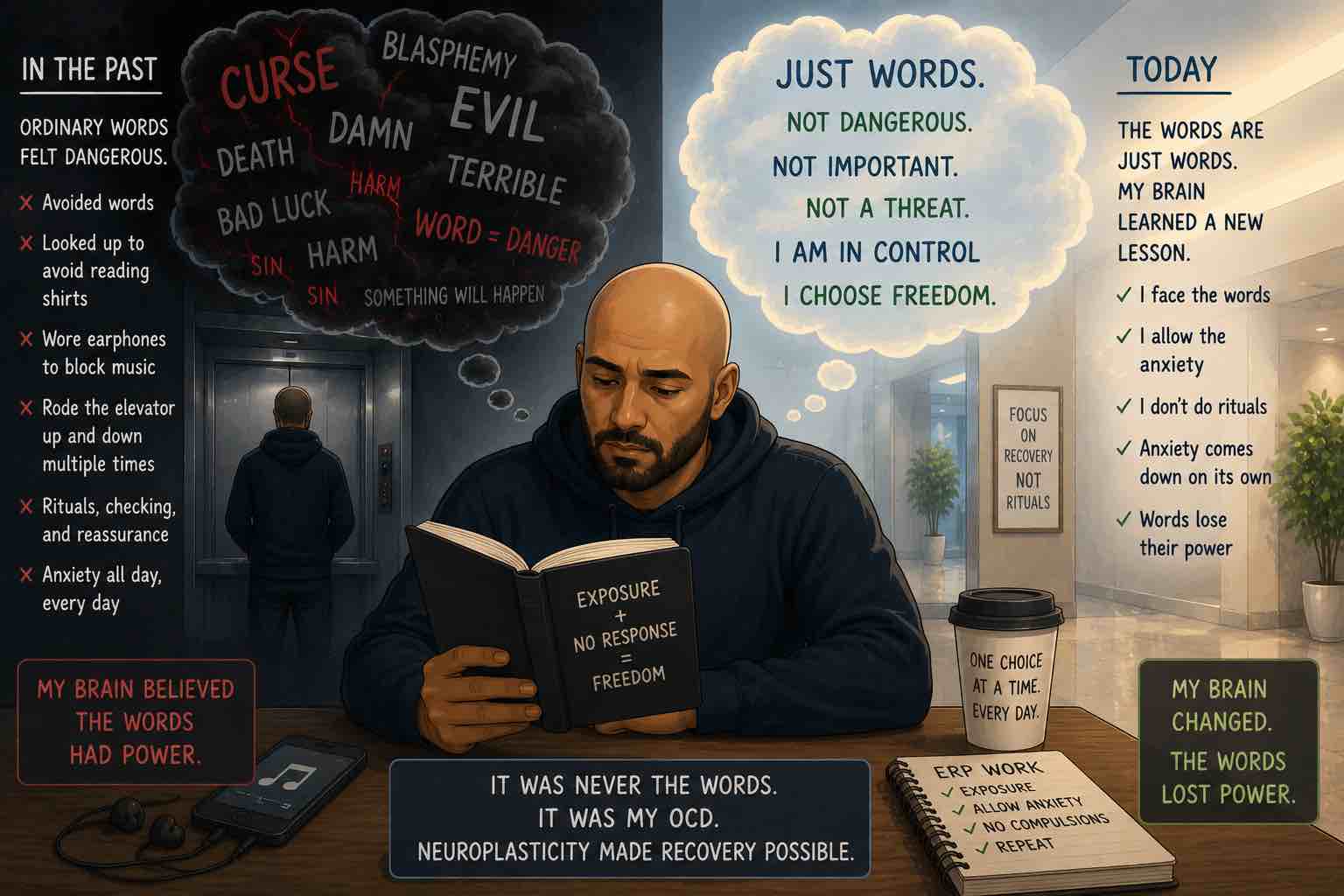
Why My Brain Thought Words Had Power
One of the strangest parts of my OCD involved ordinary words.
Not insults.
Not threats.
Just...words.
Most people can hear hundreds of words every day without giving them another thought.
I couldn't.
Certain words could completely change how my day felt. If I heard one at what my OCD considered the "wrong" moment, my anxiety would immediately spike.
Looking back now, I no longer believe those words had power.
My brain simply believed they did.
It Didn't Start That Way
I wasn't born afraid of words.
Like many people with OCD, my fears developed over time.
At some point my brain began connecting ordinary words with anxiety.
Then something interesting happened.
The more I reacted to those words, the more important they became.
Eventually my brain stopped treating them like ordinary language.
It treated them like warning signs.
Everyday Life Became Difficult
Once that happened, everyday life became exhausting.
I found myself looking toward the ceiling in elevators so I wouldn't accidentally read the writing on someone's shirt.
I wore earphones, not because I wanted to listen to music, but because I was trying to avoid hearing music from someone else's phone.
I avoided television.
I avoided certain conversations.
I even found myself scanning rooms before entering them.
The goal wasn't to enjoy life anymore.
The goal was simply to avoid one more trigger.
Unfortunately, the list never stopped growing.
The Words Never Actually Changed
One thing I eventually realized is that the words themselves never changed.
The dictionary hadn't changed.
The language hadn't changed.
The only thing changing was my brain's reaction.
That was an important realization.
If the words were objectively dangerous, everyone would react the same way.
They didn't.
Only my OCD treated them like emergencies.
Why My Brain Kept Doing It
I think my brain had simply learned a pattern.
I would hear a trigger.
I would become anxious.
I would perform a ritual or avoid something.
The anxiety would eventually come down.
My brain learned the wrong lesson.
Instead of learning that the word was harmless, it learned that the ritual must have prevented something bad.
So the next time I heard that word, it reacted even faster.
Every repetition strengthened the habit.
ERP Changed the Pattern
Exposure and Response Prevention asked me to do something that felt completely backwards.
Instead of avoiding the words, I deliberately exposed myself to them.
I wrote them.
I read them.
I listened to them.
Most importantly, I stopped trying to undo the anxiety afterward.
The first few days were difficult.
Sometimes the first couple of weeks were difficult.
But I had seen this happen with enough other triggers that I trusted the process.
Slowly, the words became...just words again.
Neuroplasticity Gave Me Hope
I believe this is where neuroplasticity played a huge role.
Every time I refused a compulsion, my brain received a new lesson.
The word appeared.
Nothing happened.
No ritual.
No disaster.
Just another ordinary day.
After enough repetition, my brain gradually stopped treating those words like danger signals.
It learned something new.
What I Think Today
If someone had told me years ago that I would one day hear those same words without caring, I would not have believed them.
Yet that is exactly what happened.
The words never changed.
I changed.
Or more accurately, my brain changed.
That is what gives me hope whenever a new trigger appears.
I remind myself that I have watched this happen before.
Today's impossible trigger can become tomorrow's ordinary word.
Not because the word lost its power.
Because it never had any to begin with.
My brain simply learned to stop treating it as if it did.