

Why Neuroplasticity Works for OCD Recovery
When I first heard the word neuroplasticity, I honestly thought it sounded too good to be true.
People were saying the brain could change. That new pathways could form. That years of OCD could gradually lose their grip through repeated practice.
I wanted to believe it, but I was skeptical.
After living with severe OCD for years and practicing Exposure and Response Prevention (ERP), I can honestly say I believe neuroplasticity is one of the biggest reasons recovery is possible.
Not because someone told me.
Because I have watched it happen to my own brain over and over again.
The Brain Learns From Repetition
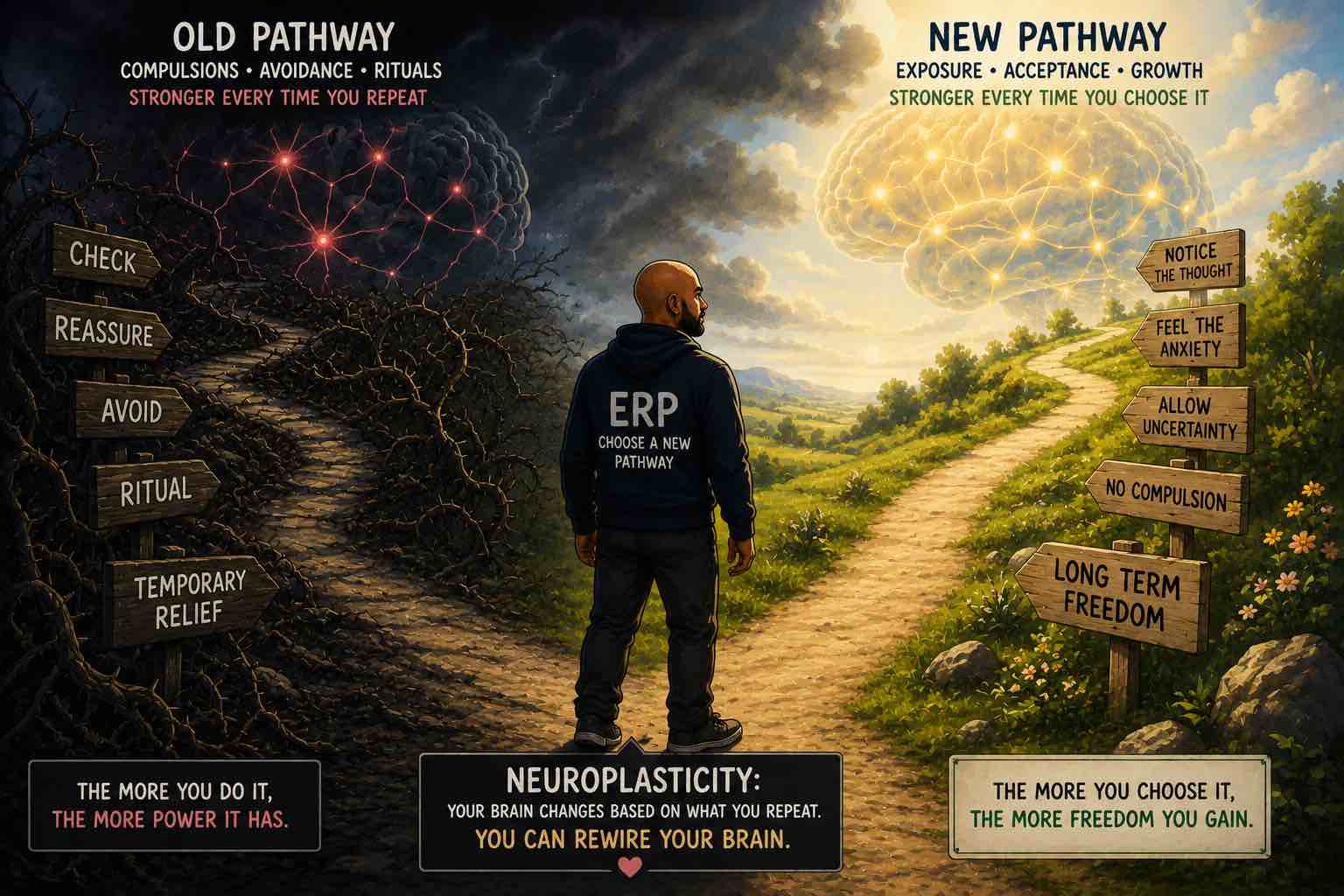
One of the simplest ways I think about neuroplasticity is this: your brain learns from whatever you repeatedly do.
If you repeat a behavior thousands of times, your brain becomes very good at it.
Unfortunately, OCD takes advantage of this.
Every ritual, every reassurance, every avoidance, and every compulsion teaches the brain the same lesson.
"That fear must have been important because we responded to it."
The more you repeat the ritual, the stronger that pathway becomes.
The brain isn't trying to hurt you. It's simply learning from repetition.
How ERP Changes the Lesson
ERP teaches the brain something completely different.
Instead of responding to every intrusive thought with a ritual, you allow the thought to exist without doing the compulsion.
At first, that feels completely wrong.
Your anxiety rises.
Your brain practically screams at you to fix the problem.
But something interesting begins to happen if you stay with the exposure.
Eventually, the anxiety starts coming down on its own.
You didn't solve the obsession.
You didn't gain certainty.
You simply allowed your brain to experience that nothing needed to happen.
That is a new lesson.
I Have Seen This Pattern Many Times
I cannot even count how many times I have gone through this cycle.
A new trigger appears.
It feels enormous.
It feels different from every other trigger.
My brain tells me this one is special.
So I deliberately add it to my ERP hierarchy.
The first few days are difficult.
Sometimes the first week is difficult.
Then something begins to change.
The same trigger that once dominated my thoughts slowly becomes... ordinary.
I have watched this happen with words, places, songs, objects, and many of my magical thinking fears.
That is why I trust the process.
Not because every exposure is easy.
Because I have seen the outcome enough times to know what usually happens if I stay consistent.
The Old Path Starts to Fade
I like to picture it as walking through a forest.
If you walk the same trail every day, it becomes easy to follow.
The grass disappears.
The path becomes clear.
That is what compulsions do.
They create a well-worn trail in the brain.
ERP asks you to stop walking that trail.
Instead, you begin walking a different path.
At first, the new path is difficult.
It feels unfamiliar.
It takes effort.
But every time you choose it instead of the old one, it becomes a little easier.
Meanwhile, the old path slowly becomes overgrown because you are no longer using it as often.
That is a simple way I think about neuroplasticity.
Why It Feels So Hard in the Beginning
Many people quit ERP because the beginning is the hardest part.
I understand why.
Your brain is asking you to stop doing something it has practiced for months or even years.
Of course that feels uncomfortable.
The discomfort is not proof that ERP is failing.
If anything, it often means your brain is learning something new.
New habits rarely feel natural on the first day.
Science Gives Me Hope
One of the things I appreciate most is that neuroplasticity is not just a motivational phrase.
Researchers have spent decades studying how the brain changes through learning and repeated experience.
That does not mean recovery happens overnight.
It does mean our brains are not permanently locked into one pattern.
I find that incredibly encouraging.
What I Remind Myself Today
Whenever I start working on a new exposure, I remind myself that I am not just resisting one compulsion.
I am teaching my brain something new.
Every exposure is another repetition.
Every resisted ritual is another repetition.
Every moment I choose uncertainty over a compulsion is another repetition.
That is how new pathways are built.
It is not dramatic.
It is not instant.
It is slow, repetitive work.
But I have tested it enough times in my own life that I no longer wonder whether it works.
I know it does.
That does not mean OCD disappears completely.
It means the brain can learn a different way to respond.
For me, that has been one of the most hopeful discoveries in my recovery.
This article reflects my personal experience living with OCD. Neuroplasticity is an active area of neuroscience research, and ERP is considered one of the most effective evidence-based treatments for OCD when guided by a qualified mental health professional.