

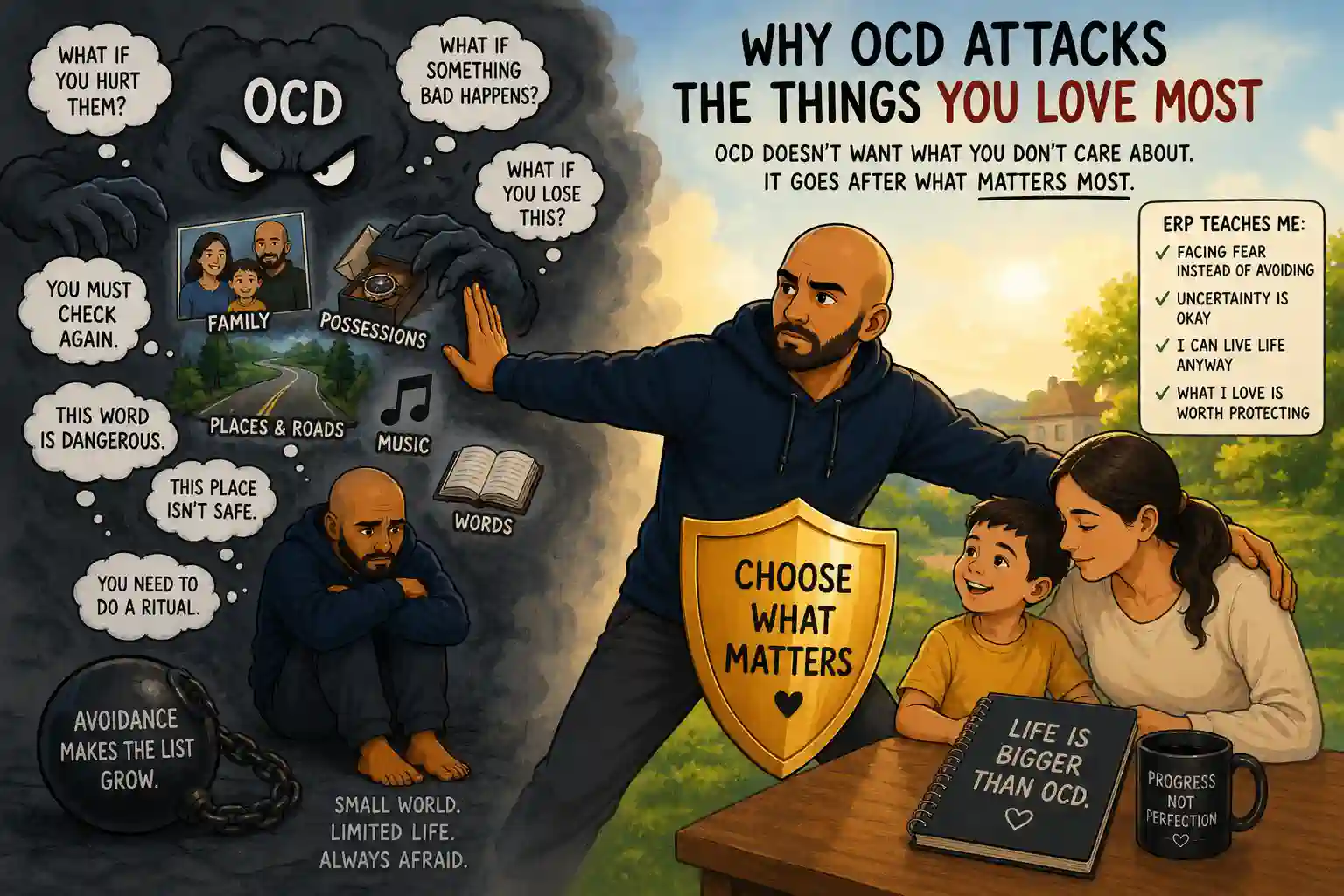
Why OCD Attacks the Things You Love Most
One of the cruelest things about OCD is that it often attacks the things you care about most.
It does not usually waste much time on things that mean nothing to you. Instead, it goes after your family, your relationships, your faith, your memories, your future, your identity, your home, and the people you love.
That is what makes it feel so personal.
But OCD is not attacking those things because they are dangerous. It is attacking them because they matter.
OCD Looks for What Has Value
If something has no emotional value, OCD usually has less to work with.
If I do not care about something, then a fear connected to it does not have much power over me. But if the fear connects to my wife, my son, my daughter, my family, my future, or my ability to live a normal life, suddenly OCD has my attention.
That is one of the reasons OCD can feel so convincing.
It wraps itself around things that already matter deeply.
For me, OCD has attacked the people I love, the places I wanted to go, the objects I cared about, and even the idea of having a normal future. It has made ordinary decisions feel dangerous simply because those decisions were connected to something meaningful.
Love Becomes Leverage
OCD knows how to use love as leverage.
If you love your family, OCD may create fears about your family.
If you care about being a good person, OCD may question your character.
If you care about your marriage, OCD may create doubt around your relationship.
If you care about your future, OCD may make every decision feel like it could ruin everything.
That does not mean those fears are true.
It means OCD found something important enough to scare you with.
My Experience With This
In my own life, OCD has attached itself to many things I cared about.
There were times when my OCD affected my ability to spend time with people I loved. It affected where I could go, what I could do, what I could buy, and how freely I could live.
Even something simple could become complicated if OCD connected it to a trigger.
A word could affect the day.
A thought could affect an object.
A ritual could decide whether I felt allowed to leave the house.
A property line could become a barrier between me and the rest of my life.
Those fears were not powerful because the objects or places were actually dangerous. They were powerful because they were connected to things I cared about.
OCD Makes You Think Protection Means Obedience
OCD often presents itself as protection.
It says, “Do this ritual so your family is safe.”
It says, “Avoid this trigger so the day is not ruined.”
It says, “Check one more time so nothing bad happens.”
It says, “Think the right thought so you can protect what matters.”
But OCD is not protection.
It is control disguised as protection.
The more I obeyed OCD to protect the things I loved, the more OCD separated me from those things.
That is the cruel part.
OCD says it is helping you protect your life while slowly taking your life away.
The Things You Love Are Not the Problem
For a long time, I thought the solution was to avoid anything that OCD attached itself to.
Avoid the place.
Avoid the word.
Avoid the object.
Avoid the situation.
Avoid the possibility of feeling triggered.
But avoidance only made the list grow.
Eventually I had to understand that the things I loved were not the problem. The trigger was not the real problem either.
The problem was the meaning OCD attached to those things.
ERP Helped Me Reclaim What OCD Attacked
Exposure and Response Prevention therapy helped me begin taking parts of my life back.
ERP did not teach me that I had to feel fearless before living.
It taught me that I could live while fear was still present.
I could face a trigger and not perform a ritual.
I could allow uncertainty to exist.
I could choose my family, my values, and my life over OCD’s rules.
That is not easy.
When OCD attacks something you love, refusing the compulsion can feel almost irresponsible. It can feel like you are risking something important.
But in reality, obeying OCD is often what keeps stealing from you.
What I Remind Myself
When OCD attacks something I love, I try to remember that the fear is strong because the thing matters to me.
That does not make the fear true.
It only means OCD found something valuable to target.
I also remind myself that love does not require compulsions.
Being a good husband does not require obeying OCD.
Being a good father does not require doing rituals.
Protecting my future does not require letting OCD control every decision.
The best way I can honor the things I love is not by obeying OCD.
It is by continuing to live, even when OCD tries to make that difficult.
OCD Attacks What Matters, But It Does Not Own It
OCD may attack the things you love most, but that does not mean it owns them.
It may create doubt around your family.
It may create fear around your relationships.
It may create anxiety around your future.
It may try to turn meaningful parts of life into sources of fear.
But those things still belong to you.
Your family belongs to you.
Your values belong to you.
Your future belongs to you.
Your life belongs to you.
OCD can make them feel dangerous, but it cannot decide what they mean unless you keep giving it that power.
That is what I am still learning.
The things I love are not reasons to obey OCD.
They are reasons to fight back.