

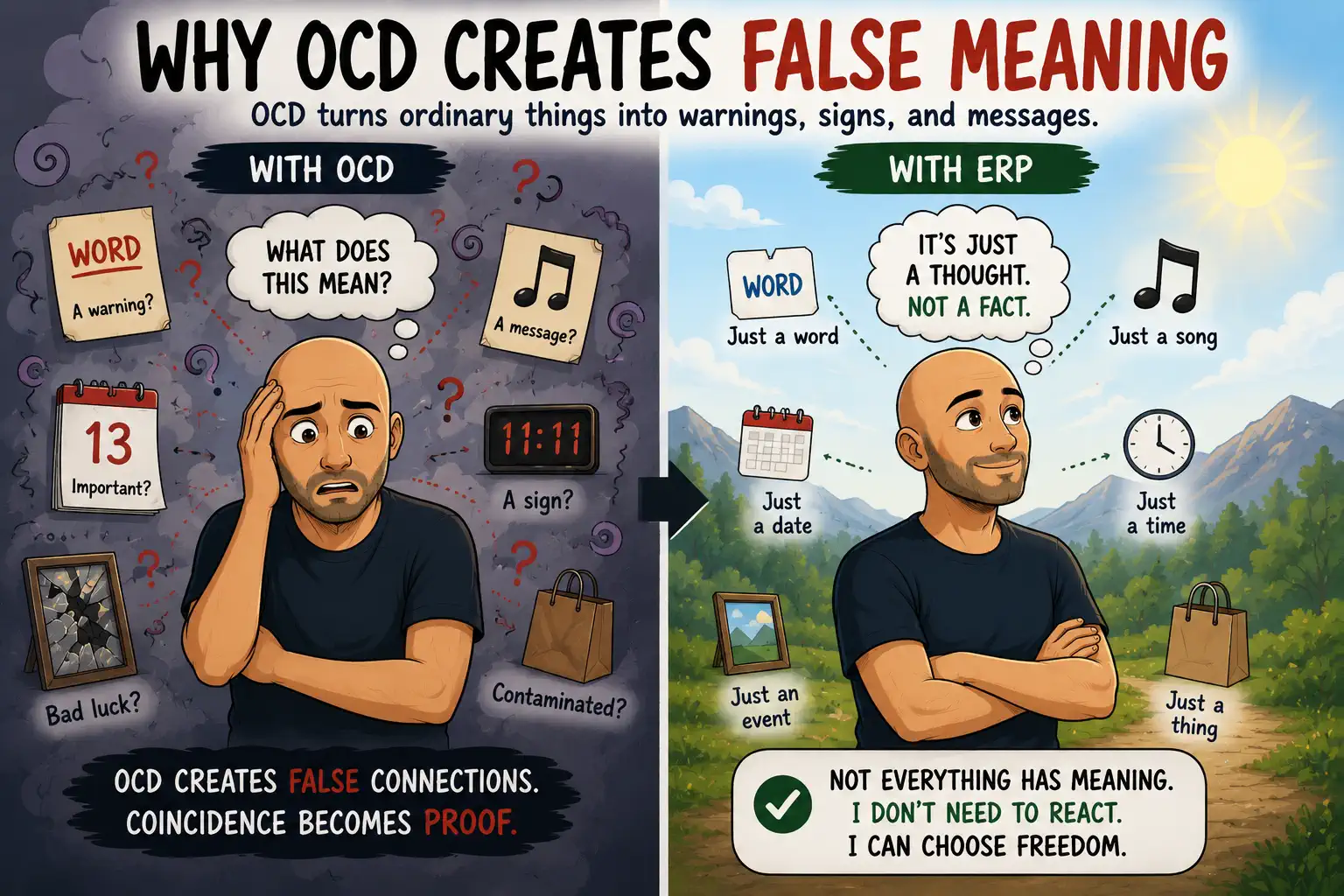
Why OCD Creates False Meaning
One of the strangest things OCD has ever done to me is convince me that ordinary things have extraordinary meaning.
A word becomes important. A song becomes important. A date becomes important. A number becomes important. A random event becomes important.
The strange part is that none of these things were important before OCD attached itself to them.
Yet once OCD gets involved, they can suddenly feel like the most important thing in the world.
The Human Brain Loves Patterns
Our brains are pattern-recognition machines. They are constantly looking for connections.
This ability can be useful, but sometimes the brain finds patterns that do not actually exist.
OCD does something similar. It creates meaning where no meaning exists.
Magical Thinking and False Meaning
This is where magical thinking OCD often enters the picture.
At my worst, I believed certain words could affect the outcome of my day. Certain songs could contaminate events. Certain triggers could somehow spread bad luck.
Logically, I knew these things made little sense. Emotionally, they felt completely real.
OCD says, "But what if?" and suddenly the false meaning becomes difficult to ignore.
Metaphysical Contamination
One of the most difficult forms of OCD I have personally dealt with is what I call metaphysical contamination.
Most people think contamination OCD is about germs. For some people it is. For me, it often had nothing to do with germs at all.
Instead, contamination involved meaning.
A trigger could contaminate an object. A word could contaminate a purchase. A thought could contaminate an experience.
The contamination was not physical. It was symbolic.
OCD had attached meaning where none existed.
How Coincidences Become Evidence
One of OCD's favorite tricks is using coincidences as evidence.
Imagine you encounter a trigger. Later that day, something bad happens.
Most people would view those events as unrelated.
OCD sees a connection.
The problem is that life is full of coincidences. Bad things happen. Good things happen. Random things happen.
OCD collects coincidences and treats them like proof while ignoring the hundreds of times nothing happened at all.
Why False Meaning Feels Real
One of the biggest misunderstandings about OCD is that people assume sufferers fully believe these things.
The reality is often more complicated.
For me, the issue was not belief. It was uncertainty.
I could recognize that a fear made no logical sense. I could understand that a word probably had no power. I could acknowledge that a coincidence was probably just a coincidence.
The problem was that "probably" was never enough.
OCD wanted certainty. It wanted a guarantee.
And since certainty is impossible, the doubt remained.
Breaking the Meaning
One of the most important lessons ERP taught me was that I did not need to remove the thought.
I needed to remove the meaning.
Those are very different things.
For years I tried to avoid triggers, words, songs, situations, and thoughts.
The more I avoided them, the more important they became.
Eventually I learned to do the opposite.
I exposed myself to them. I wrote down triggering words. I listened to triggering songs. I allowed uncomfortable thoughts to exist.
At first, the meaning remained.
Then something interesting happened.
The more I exposed myself without performing rituals, the less meaningful the trigger became.
The brain slowly stopped treating it like a threat.
The Meaning Was Never There
When I look back at some of my strongest OCD triggers, I can see something now that I could not see then.
The meaning was never there.
OCD created it. Then OCD convinced me it was important. Then OCD demanded rituals to deal with it.
The entire system depended on accepting the false meaning as real.
Once I began questioning the meaning itself, the system started falling apart.
That does not mean OCD disappeared. I still have OCD. I still experience triggers. I still experience doubt.
But I understand something today that I did not understand years ago.
A word is a word. A song is a song. A coincidence is a coincidence.
And just because OCD attaches meaning to something does not mean the meaning was ever there in the first place.