

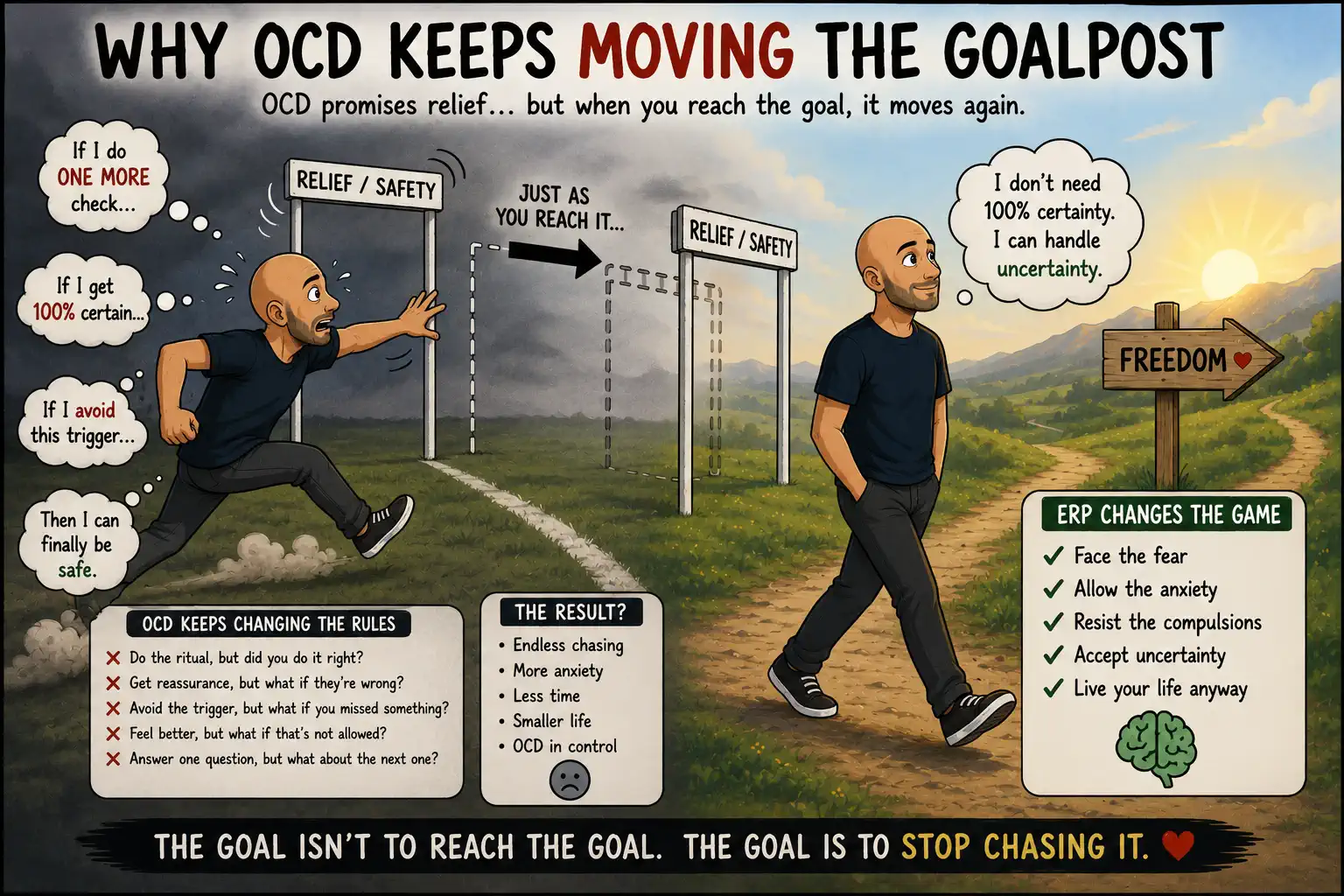
Why OCD Keeps Moving the Goalpost
One of the most frustrating things about OCD is that it never seems satisfied.
You do the ritual. You check one more time. You repeat the thought. You avoid the trigger. You try to get the feeling just right.
For a moment, you feel better.
Then OCD changes the rules.
That is what I mean when I say OCD keeps moving the goalpost. It promises relief if you complete one task, but once you finish, it usually asks for something else.
One More Time Is Never Really One More Time
OCD loves the phrase "one more time."
One more check.
One more ritual.
One more thought.
One more attempt to feel certain.
The problem is that "one more time" almost never means one more time. It usually means the beginning of another loop.
I have experienced this with property line rituals, triggering words, metaphysical contamination, and mental compulsions. OCD would tell me that if I crossed the line correctly, thought the right image, or avoided the right trigger, then I could move on with my day.
But even when I completed the ritual, the relief did not last.
Suddenly the thought was not right enough. The image was not clear enough. The feeling was not clean enough. The timing was not perfect enough.
The goalpost moved again.
OCD Does Not Want a Solution
For a long time, I thought I was solving problems.
I thought I was protecting my day, preventing something bad, or making sure things were safe.
But eventually I realized OCD was not looking for a solution.
OCD was looking for obedience.
That is an important difference.
If OCD actually wanted a solution, then one completed ritual would be enough. One answer would be enough. One reassurance would be enough.
But it never is.
OCD always finds another angle.
Maybe you did the ritual, but did you do it with the right thought?
Maybe you got reassurance, but what if the person misunderstood you?
Maybe you avoided the trigger, but what if you accidentally saw something related to it?
Maybe you felt better, but what if feeling better means you missed something?
That is how OCD keeps you trapped.
The Rules Keep Changing
One of the cruelest parts of OCD is that the rules are not stable.
What worked yesterday may not work today.
A ritual that once gave relief may suddenly stop helping.
A trigger you finally overcame may be replaced by a new one.
A fear that seemed settled may return with a slightly different question.
This can make recovery feel exhausting because OCD is always trying to rewrite the contract.
For me, this happened many times. I would overcome one triggering word, only for another word or phrase to appear. I would challenge one contamination fear, only for OCD to attach the same fear to a different object, place, or thought.
That is when I started realizing the theme was not the real issue.
The pattern was the issue.
The Theme Is Not Special
OCD makes every theme feel urgent and unique.
When I was dealing with metaphysical contamination, it felt like that was the real problem. When I was dealing with property line rituals, that felt like the real problem. When triggering words controlled my day, those words felt like the real problem.
But underneath all of them was the same disorder making the same demand.
Get certainty.
Remove doubt.
Do the ritual.
Feel safe.
Then repeat.
Once I understood that, I stopped treating every new OCD theme like a brand-new emergency.
It was still uncomfortable. It was still scary. But I began seeing the pattern faster.
How ERP Changes the Game
Exposure and Response Prevention therapy helped me understand why chasing OCD never works.
ERP does not try to win by satisfying OCD's rules.
It wins by refusing to play by those rules.
Instead of doing one more ritual, ERP asks me to allow the anxiety to exist.
Instead of chasing certainty, ERP asks me to tolerate uncertainty.
Instead of proving OCD wrong every single time, ERP teaches me that I do not need to answer every question.
That is hard.
It feels wrong at first because OCD insists that the next ritual is necessary.
But if the goalpost keeps moving, then the solution cannot be to keep chasing it.
What I Try to Remember
Today, when OCD demands one more ritual, I try to remember how many times "one more" became ten more, fifty more, or an entire morning lost.
I remind myself that relief is not the same as freedom.
Relief is what OCD offers after I obey.
Freedom is what slowly grows when I stop obeying.
OCD will always try to move the goalpost. That is what it does.
My job is not to keep chasing it.
My job is to notice the game and choose not to play.