

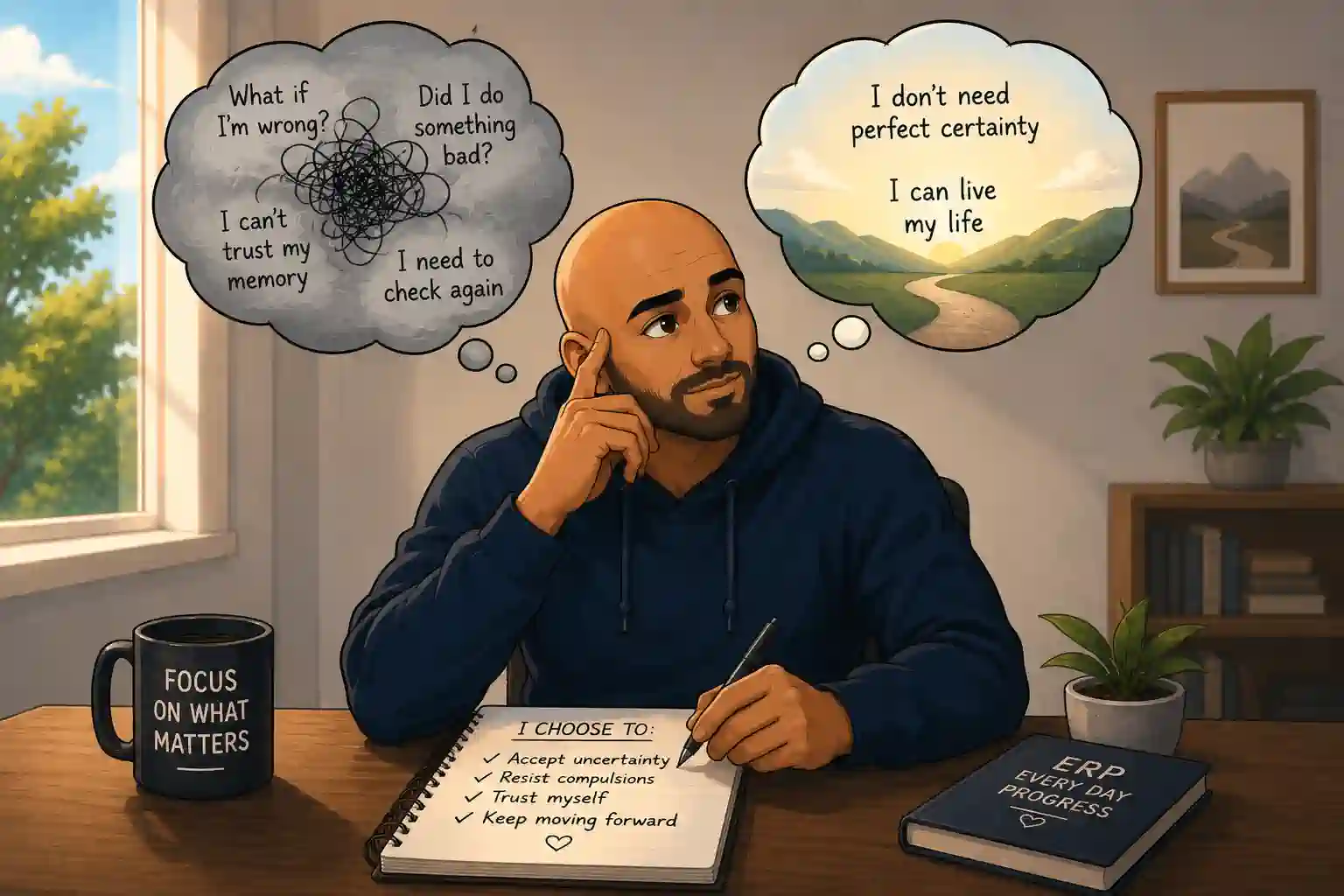
Why OCD Makes You Distrust Yourself
One of the hardest parts of OCD is that it can make you stop trusting yourself.
You may know what you saw. You may know what you meant. You may know what happened. You may even know, logically, that the fear does not make sense.
But OCD still asks, “Are you sure?”
That question can become exhausting.
For me, OCD has often attacked my ability to trust my own memory, my own decisions, and even my own intentions. It can make something simple feel complicated. It can turn an ordinary choice into a mental courtroom where I feel like I have to prove myself innocent before I am allowed to move on.
OCD Turns Doubt Into a Habit
Everyone experiences doubt sometimes.
That is normal.
But OCD takes doubt and turns it into a habit. It makes doubt feel urgent, dangerous, and unacceptable.
Instead of thinking, “Maybe I am unsure, but I can move on,” OCD says, “You need to figure this out right now.”
That is where the cycle begins.
You check. You review. You replay the memory. You ask for reassurance. You repeat the ritual. You try to feel certain.
For a moment, you may feel better.
Then OCD asks again.
“But what if you missed something?”
My Experience With Not Trusting Myself
In my own life, OCD has made me doubt things that should have been simple.
Did I cross the property line correctly?
Did I have the right thought when I did it?
Did that word contaminate the day?
Did I buy something at the wrong time?
Did I perform the ritual correctly, or do I need to do it again?
From the outside, these questions may sound strange. From inside OCD, they can feel extremely serious.
That is the problem. OCD does not need a logical argument to create fear. It only needs enough doubt to make you question yourself.
Feelings Start Looking Like Evidence
OCD often makes feelings look like evidence.
If I feel anxious, OCD says something must be wrong.
If I feel uncertain, OCD says I need to check.
If I feel uncomfortable, OCD says I should avoid the situation.
But feelings are not always facts.
Anxiety can be real without the danger being real.
Doubt can be real without the fear being true.
Discomfort can be real without needing a compulsion.
Learning that difference has been one of the most important parts of my recovery.
Why Reassurance Does Not Fix It
When OCD makes you distrust yourself, reassurance feels very tempting.
You want someone to tell you that you are okay.
You want proof that nothing bad happened.
You want certainty that your memory, thought, or decision was safe.
The problem is that reassurance usually does not last.
It may calm you for a few minutes, but OCD often comes back with another question.
Maybe the person misunderstood.
Maybe you explained it wrong.
Maybe there is one detail you forgot.
Maybe you need to ask again.
That is how reassurance becomes part of the same trap.
ERP Teaches a Different Kind of Trust
Exposure and Response Prevention therapy has helped me rebuild trust in a different way.
ERP does not teach me to feel perfectly certain.
It teaches me that I can move forward without perfect certainty.
That is a big difference.
For years, I thought trusting myself meant feeling completely sure.
Now I understand that trust often means acting according to my values even when OCD is still making noise.
It means saying, “Maybe I am uncertain, but I am not going to repeat the ritual.”
It means saying, “Maybe this feels wrong, but I am going to continue my day.”
It means saying, “I do not need to solve every doubt before I live my life.”
You Are Not Your OCD
OCD can make you feel like you cannot trust yourself, but that does not mean OCD is telling the truth.
A disorder that constantly demands rituals, avoidance, reassurance, and certainty is not a reliable guide.
OCD has been wrong in my life many times.
It told me certain words mattered when they did not.
It told me rituals protected me when they did not.
It told me avoidance was safety when it only made my world smaller.
So when OCD tells me I cannot trust myself, I try to remember its track record.
It has not earned the authority it asks for.
What I Remind Myself Today
I still struggle with doubt.
I still have moments where OCD makes me question myself.
But today I try not to treat every doubt as something that needs to be solved.
Sometimes doubt is just doubt.
Sometimes anxiety is just anxiety.
Sometimes an uncomfortable feeling is not a warning, but just another symptom of OCD.
Trusting myself does not mean I never feel afraid.
It means I stop letting OCD make every decision for me.
And that is where real recovery begins.