

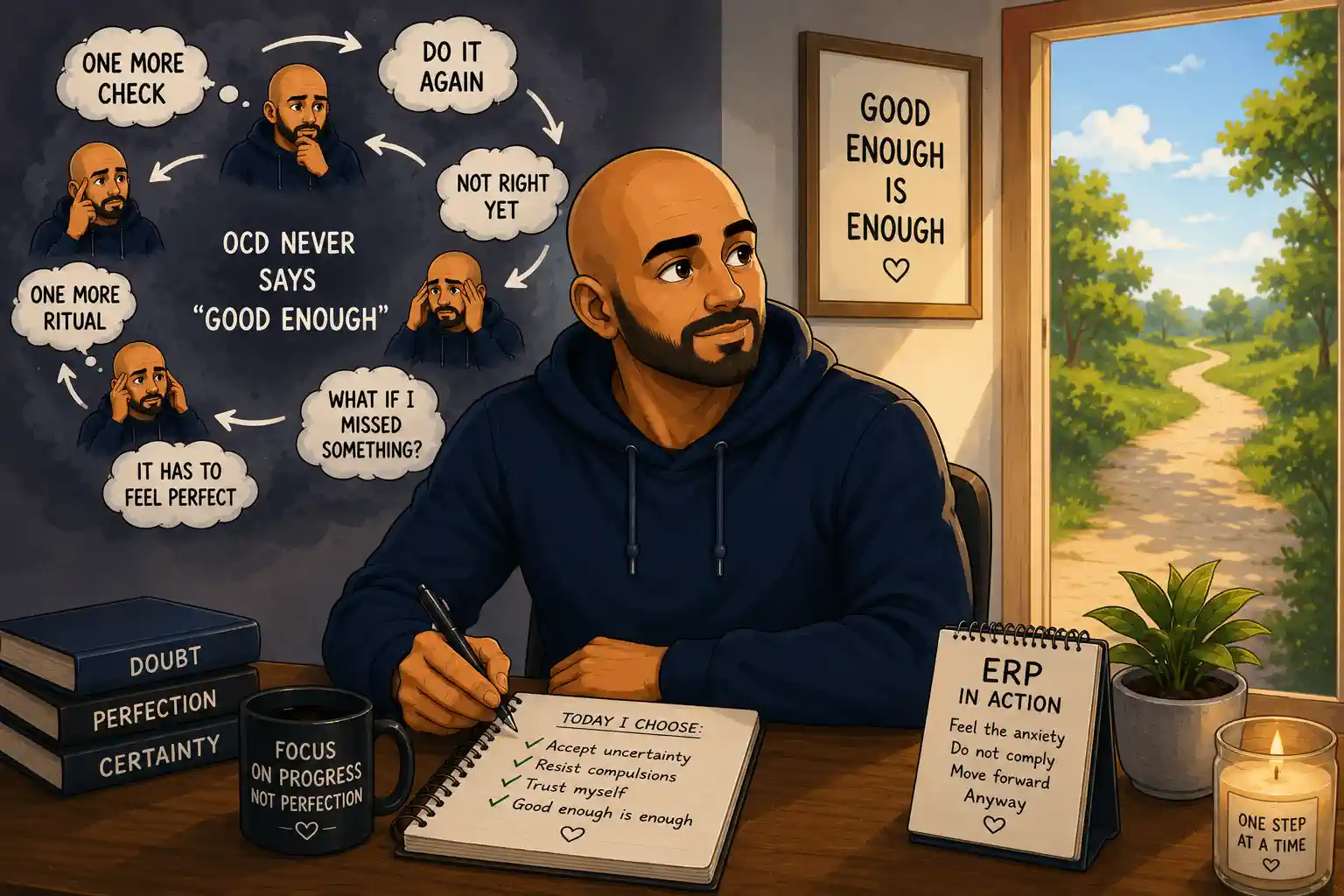
Why OCD Never Says “Good Enough”
One thing OCD almost never says is, “That is good enough.”
It always wants more.
One more check. One more ritual. One more thought. One more attempt to get the feeling right. One more try to make sure nothing bad will happen.
That is one of the reasons OCD is so exhausting. It does not usually stop because the task is finished. It stops only when anxiety drops enough for a short time.
And even then, it usually comes back.
The Feeling Is Never Quite Right
For me, OCD often demanded that things feel exactly right before I could move on.
Getting dressed could become difficult because my thoughts had to feel right. Leaving the house could become difficult because the ritual had to feel complete. Crossing a property line could become difficult because my OCD wanted the right mental image, the right timing, and the right feeling.
From the outside, these things may look simple.
Put on clothes.
Walk outside.
Cross a line.
Continue the day.
But inside OCD, simple things can become complicated very fast.
If the thought was not right, I had to do it again. If the feeling was not right, I had to repeat it. If there was doubt afterward, OCD told me the ritual did not count.
That is how “good enough” disappeared from my life.
OCD Keeps Raising the Standard
The hardest part is that OCD does not keep the same rules.
What counted yesterday may not count today.
A ritual that worked last week may suddenly feel incomplete. A thought that once gave relief may stop working. A trigger that seemed manageable may come back with a new angle.
OCD keeps raising the standard until the standard becomes impossible.
That is when you realize the problem was never about doing the ritual correctly.
The problem was OCD demanding certainty that no human being can actually have.
Temporary Relief Is Not the Same as Completion
For a long time, I confused relief with completion.
If I felt better after a ritual, I assumed the ritual worked.
But now I see it differently.
The ritual did not solve the problem. It only lowered the anxiety for a little while.
That is why OCD never says “good enough.”
It is not looking for a real solution.
It is looking for temporary relief.
And temporary relief always expires.
Why “Good Enough” Feels Dangerous
To someone without OCD, accepting “good enough” may sound easy.
To someone with OCD, it can feel dangerous.
OCD says, “What if good enough is not enough?”
What if you missed something?
What if you did it wrong?
What if the thought was not correct?
What if this time is different?
That last one is powerful.
“This time is different” is one of OCD’s favorite tricks.
It makes every fear feel special. Every trigger feels urgent. Every ritual feels necessary. Every decision feels too important to risk.
But after enough years with OCD, I started seeing the pattern.
The theme changed, but the demand stayed the same.
OCD wanted certainty.
It wanted perfection.
It wanted a guarantee.
And it never gave one back.
ERP Taught Me to Practice “Good Enough”
Exposure and Response Prevention therapy taught me that I do not have to wait for the perfect feeling before moving on.
That was extremely hard at first.
ERP often asks you to leave things unfinished according to OCD’s standards.
You feel the anxiety, but you do not do the ritual.
You feel the doubt, but you do not chase certainty.
You feel like something is wrong, but you continue anyway.
That is where recovery begins.
Not because the fear disappears immediately, but because you teach your brain that life can continue without completing OCD’s impossible checklist.
Good Enough Is a Skill
I used to think “good enough” was just something normal people naturally had.
Maybe for some people it is.
For me, it had to become a skill.
I had to practice stopping before OCD felt satisfied.
I had to practice leaving uncertainty alone.
I had to practice continuing my day even when my brain said the ritual was incomplete.
It did not feel natural.
It still does not always feel natural.
But it has helped me regain parts of my life that OCD tried to take.
What I Remind Myself Today
OCD may never say “good enough.”
So sometimes I have to say it myself.
Good enough to move on.
Good enough to stop checking.
Good enough to leave the ritual unfinished.
Good enough to continue the day.
That does not mean the anxiety disappears right away.
It means I stop letting OCD decide when I am allowed to live.
OCD wants perfection, but recovery does not require perfection.
Sometimes recovery begins with accepting something that feels unfinished and choosing to move forward anyway.