

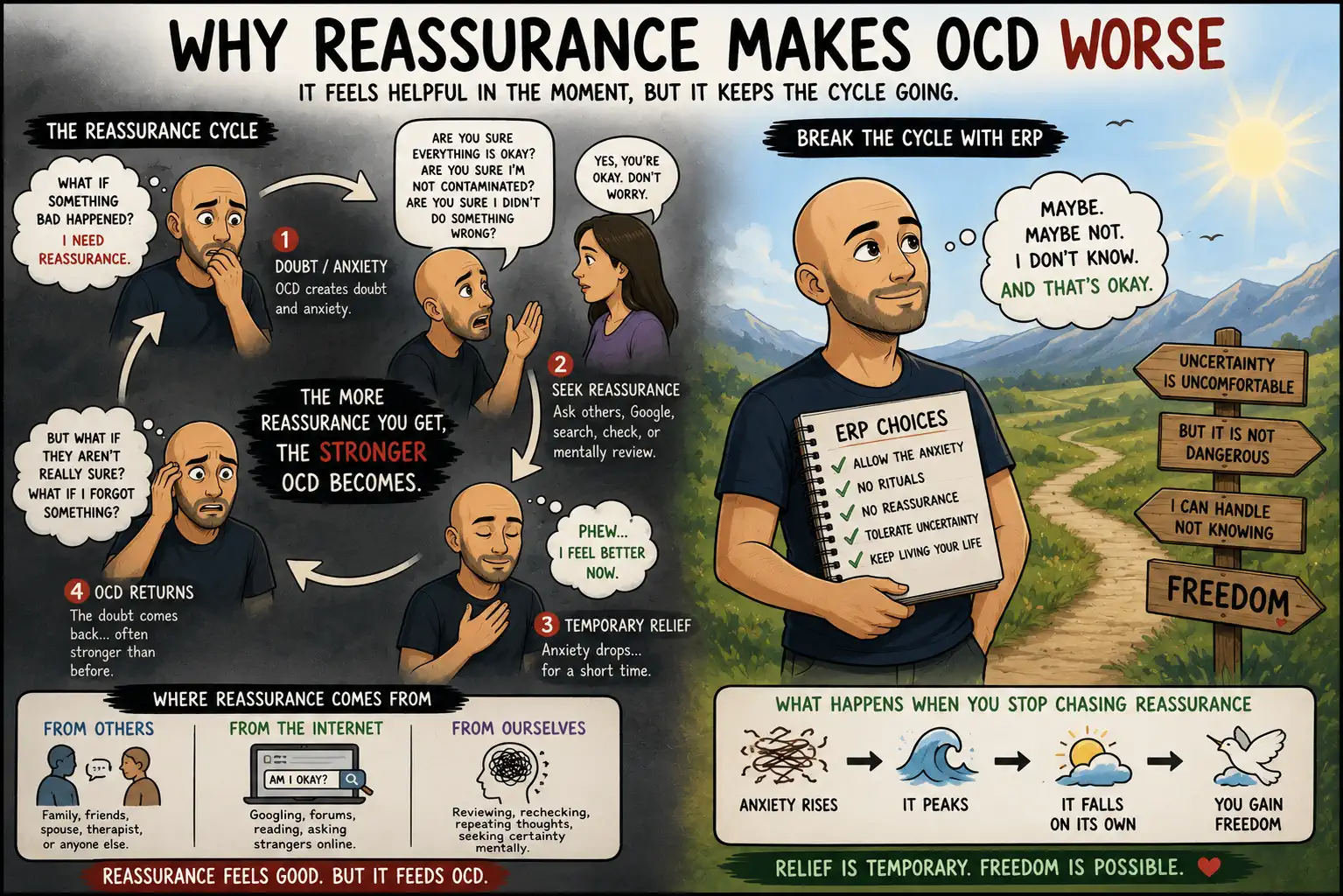
Why Reassurance Makes OCD Worse
One of the strangest things I learned about OCD is that reassurance can actually make the disorder stronger.
That sounds completely backwards.
After all, if someone is anxious, would reassurance not help them?
In the short term, yes.
In the long term, not usually.
In fact, reassurance became one of the biggest traps in my OCD.
What Reassurance Looks Like
Reassurance can take many forms.
Sometimes it comes from another person.
"Are you sure everything is okay?"
"Are you sure this is not contaminated?"
"Are you sure I did not do something wrong?"
Sometimes reassurance comes from the internet.
Hours spent searching websites, reading forums, and looking for someone who has the exact same fear.
Sometimes reassurance comes from ourselves.
Reviewing memories, repeating thoughts, mentally checking events, and trying to convince ourselves that nothing bad happened.
No matter where reassurance comes from, the goal is usually the same.
We want certainty.
We want to feel safe.
We want the anxiety to stop.
The Problem With Reassurance
The problem is that reassurance works.
At least temporarily.
You ask the question. Someone gives you the answer. The anxiety drops. You feel better.
For a little while.
Then OCD returns.
Maybe an hour later. Maybe tomorrow. Maybe five minutes later.
Now the same question appears again.
"But are you really sure?"
The first answer is no longer enough.
You need a second answer. Then a third. Then a fourth.
Eventually, the reassurance that once worked stops working entirely.
My Experience With Reassurance
I used to think reassurance was helping me.
If I was worried about a trigger, I wanted reassurance.
If I was worried about contamination, I wanted reassurance.
If I was worried about a ritual, I wanted reassurance.
The relief felt amazing.
For a few minutes.
Then OCD would find another angle.
Maybe I forgot something. Maybe the answer was not complete. Maybe the person did not understand the question. Maybe I should ask again.
I was not looking for answers anymore.
I was looking for relief.
There is a difference.
The Bottomless Pit
The best way I can describe reassurance is a bottomless pit.
No matter how much reassurance you pour into it, OCD always wants more.
That is why family members can become exhausted. Friends become frustrated. Spouses become confused.
They answer the same question dozens of times, but no answer ever seems to be enough.
The reason is simple.
OCD is not seeking information.
OCD is seeking certainty.
And certainty does not exist.
Why ERP Feels So Different
Exposure and Response Prevention therapy taught me something uncomfortable.
Sometimes the answer is not another answer.
Sometimes the answer is uncertainty.
When OCD asks a question, ERP teaches us not to solve it.
Instead, we learn to tolerate not knowing.
That felt impossible when I first heard it.
But answering the question was never truly helping.
The relief always disappeared. The question always returned. The cycle always repeated itself.
Freedom Starts With Letting Questions Exist
One of the biggest changes in my recovery happened when I stopped trying to answer every OCD question.
Not because I suddenly became fearless.
Not because I suddenly stopped caring.
But because I finally realized that reassurance was not solving anything.
It was feeding the disorder.
Today OCD still asks questions.
It still creates doubt.
It still wants reassurance.
The difference is that I no longer feel obligated to answer every question it asks.
Sometimes the best response is:
"Maybe."
"Maybe not."
"I do not know."
Those answers drive OCD crazy.
But they also weaken its grip over time.
The Relief Never Lasted Anyway
When I look back, I realize that reassurance never gave me what I was truly looking for.
I wanted freedom.
Reassurance only offered temporary relief.
Freedom came when I stopped chasing certainty and started accepting uncertainty.
The answer I was looking for was never another reassurance.
The answer was learning that I could live without one.